Stocking Your Fridge for Thanksgiving? We Tested What Happens as Your Refrigerator Gets Packed
Quick answer
Refrigerator not cooling after you packed it for the holiday? A full fridge usually isn’t the problem by itself. In our model, cold food acts like a thermal battery: one long door opening warmed the food in a half-full fridge by about 0.07°F and in a 90%-full fridge by about 0.01°F. The usual culprits are food pushed against the air vents, which cuts off the cold air, and a load of warm groceries or drinks, which can bring in as much heat as 60 to 130 door openings.
It’s the week before Thanksgiving. The turkey is thawing on the bottom shelf, drinks are wedged in the door, and the crisper won’t close. Then the milk feels less cold than usual and you wonder: is my refrigerator not cooling because it’s too full?
We tested it, virtually. This is a calculation and simulation, not a measurement in a real kitchen: we built a heat-balance model of a common 25 cu ft French-door refrigerator and compared what happens to its stored food at three levels of fullness, plus a case with a vent blocked. USDA food-safety guidance comes first, and nothing here replaces it.
What we tested
A representative 25 cu ft French-door refrigerator with 17.75 cu ft of fresh-food space, set to 37°F in a 72°F kitchen. We changed one thing at a time: how full the fresh-food section is, and whether an air vent is blocked.
- Loads: about 50%, 75% and 90% of the shelf space filled with food, vents clear; then 90% full with a vent blocked
- Door opening: a long opening that swaps all the cold air left in the compartment for 72°F room air (the worst case)
- Restocking: 10 lb and 20 lb of room-temperature drinks loaded into a half-full fridge
- Measured in the model: food thermal mass, free air space, heat brought in, and the temperature rise of the stored food
- Result type: calculated and modeled estimates, not measurements
How we modeled a packed fridge
Our representative unit is the Whirlpool WRF535SMH, a 36-inch French-door model listed in the ENERGY STAR database at 25.2 cu ft and 615 kWh a year. Its fresh-food section is 17.75 cu ft and its freezer 7.44 cu ft. Those two figures match the “adjusted volume” ENERGY STAR lists for it under the federal test formula, which is a good check that we have the right split.
| Input | Value | Source |
|---|---|---|
| Fresh-food space | 17.75 cu ft | ENERGY STAR listing and federal adjusted-volume formula (manufacturer specification) |
| Fridge temperature | 37°F | Whirlpool factory setting |
| Kitchen temperature | 72°F | DOE refrigerator test procedure “typical room conditions” |
| Specific heat of food | 0.90 Btu per lb per °F | Average of ASHRAE values for potatoes, apples, lettuce and milk (published measurement) |
| Food packed into the space it fills | 10 lb per cu ft | Our assumption (tested at 5 and 20) |
| Room-temperature drinks | 72°F, about 1.0 Btu per lb per °F | Water properties (ASHRAE) |
“Percent full” means how much of the shelf space food takes up, gaps included. Our 10 lb per cubic foot is a mixed fridge of produce, leftovers, jars and drinks: about 89 lb of food at half full and 160 lb at 90%.
One number we could not find from a reliable source is how fast this fridge’s compressor and fans remove heat. So we did not calculate recovery minutes after the door closes. We compared how much heat comes in with how much cold food is there to absorb it. The comparison between 50%, 75% and 90% holds whatever the exact food weight is.
Results: what changes as the fridge fills
| Scenario | Food stored (assumed) | Cold air left | Heat in per long opening | Food warms per opening | After 10 openings, no cooling |
|---|---|---|---|---|---|
| 50% full, vents clear | 89 lb | 8.9 cu ft | 5.6 Btu | 0.07°F | 0.69°F |
| 75% full, vents clear | 133 lb | 4.4 cu ft | 2.8 Btu | 0.02°F | 0.23°F |
| 90% full, vents clear | 160 lb | 1.8 cu ft | 1.1 Btu | 0.01°F | 0.08°F |
| 90% full, vent blocked | 160 lb | 1.8 cu ft | 1.1 Btu | Same | Not modeled: cold air supply cut off |
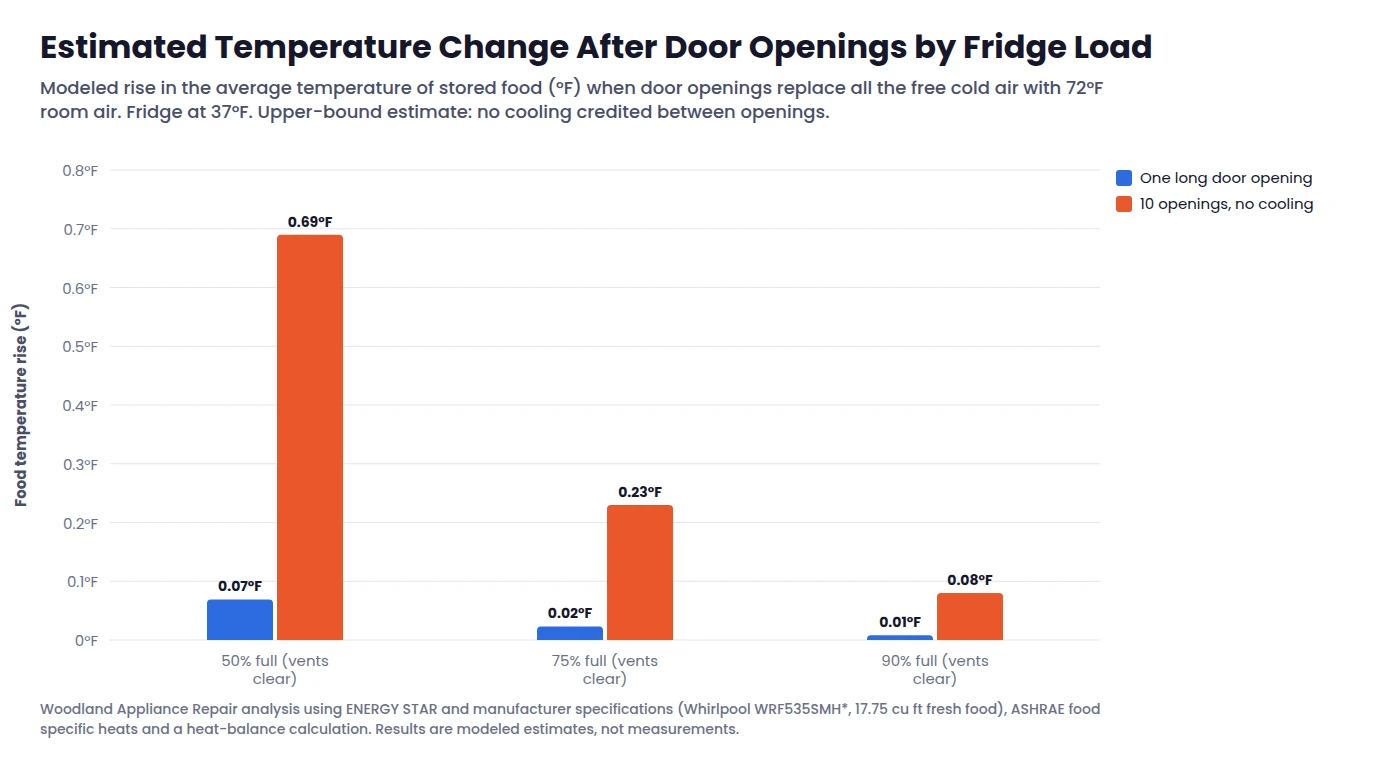
The chart shows the counterintuitive part. A fuller fridge loses less, not more, when you open the door. Two things happen at once. There’s less cold air to spill out, so less warm air comes in, and there’s more cold food to share that small amount of heat. Going from half full to 90% full cut the modeled food temperature rise per opening by about 90%. A full shelf on its own is rarely the reason for a refrigerator not cooling.
Even in the half-full fridge, the food barely moves: it would take about 14 long openings with no cooling at all to warm it by 1°F. The air can feel warm for a minute after the door closes, but food changes temperature slowly.
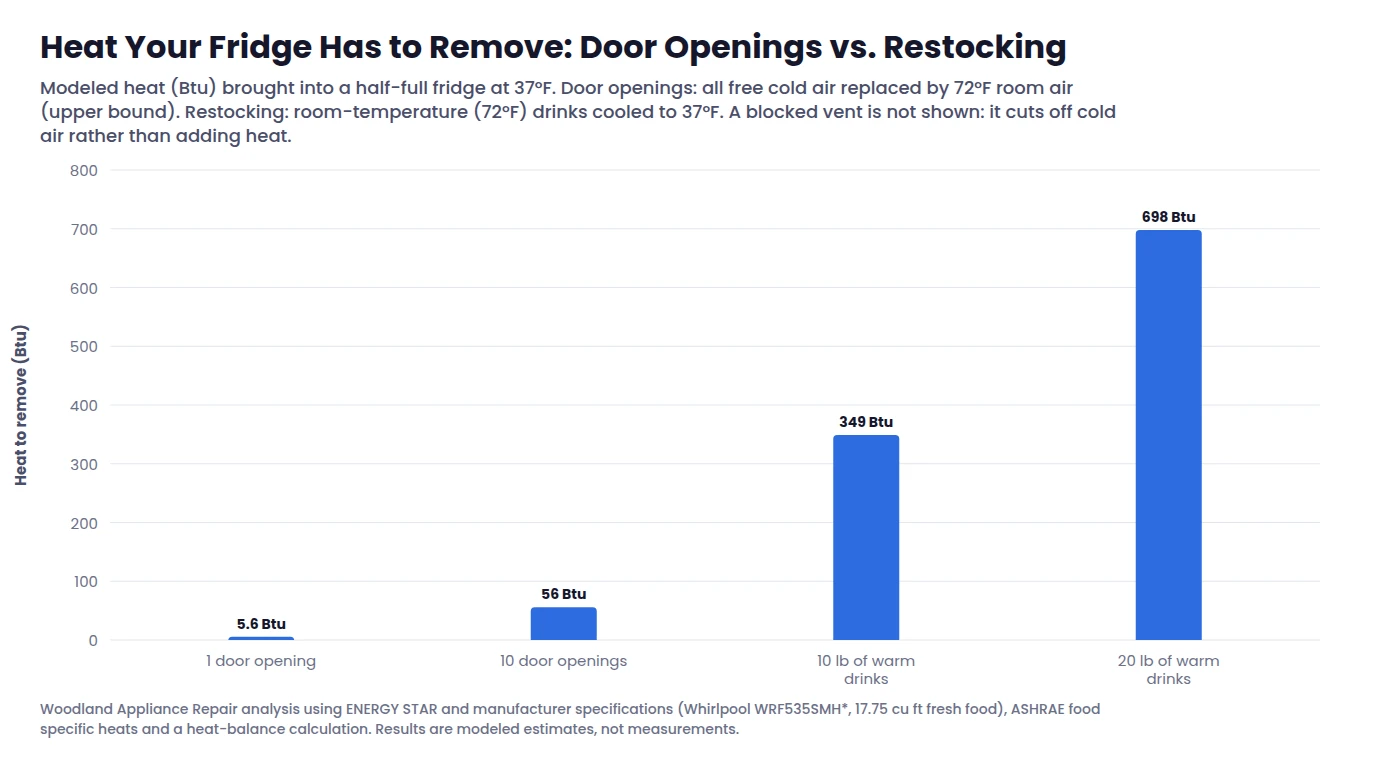
The second chart is where holiday trouble really comes from. Loading 20 lb of room-temperature drinks puts about 698 Btu of heat into the fridge, the same as 126 long door openings. If the fridge did no cooling at all, that would be enough heat to warm everything in a half-full fridge by about 8.7°F. The fridge has to pull all of that out, and the food sitting next to the warm bottles feels it first. For a few hours, that can look like a refrigerator not cooling.
The blocked-vent case: why a refrigerator not cooling is often an airflow problem
A blocked vent doesn’t change how much heat comes in. It changes whether cold air can get where it needs to go. In most frost-free refrigerators, cold air is blown in through vents from the evaporator area and returns through other openings. Whirlpool’s user instructions list “Air vents are blocked” as a cause of a refrigerator that is too warm and also one that is too cold, with the fix: “Remove items that are immediately in front of the vents.”
USDA puts it plainly in its guidance for cooking for large groups: “Don’t overfill the refrigerator. Cool air must circulate to keep food safe.” We could not put a number on a blocked vent without the fan and coil data manufacturers don’t publish, so we’re not going to invent one. What the model does show is that at 90% full only about 1.8 cu ft of open air is left. That’s the space the cold air has to travel through, so a single box in the wrong spot can matter.
That’s why a refrigerator not cooling at the back of a packed shelf while the front stays cold is often an airflow problem. It’s also why food next to a vent can freeze. And a refrigerator not cooling evenly after a big grocery run may simply be working through the heat in the new food.
What this means for your home
- A full fridge is fine. Cold food stabilizes the temperature. Don’t empty shelves out of worry that the fridge is “too full.”
- Keep the vents clear. Find where the cold air comes in (your manual shows it) and keep boxes and bottles from sitting right in front of it, as Whirlpool advises.
- Pre-chill drinks somewhere else. A cooler with ice or a cold garage keeps warm cases of drinks from loading the fridge right before the holiday.
- Leave gaps between items. Staggered containers with small spaces between them let air move. Solid walls of boxes don’t.
- Use a thermometer. USDA recommends 40°F or below. An appliance thermometer on a middle shelf is the best way to tell a busy fridge from a refrigerator not cooling at all.
When your fridge could behave differently
- Different designs: side-by-side and top-freezer models route air differently. Check your manual for where the vents are.
- Lots of warm food at once: our model doesn’t include cooking leftovers, a big thawing turkey or bags of groceries that sat in a warm car. Each adds heat in its own way.
- Humid kitchens: we counted only the heat in the air. Moisture also has to be removed; a 2025 study found door openings made up about half of one fridge’s daily load.
- Older or failing units: a weak fan, a frosted-over coil or a dirty condenser can’t keep up even with clear vents. That’s a refrigerator not cooling for mechanical reasons, and loading the fridge differently won’t fix it.
- Our food weight is an assumption. If your fridge holds half as much food as we assumed, the per-opening rise doubles. It stays a small fraction of a degree.
Food-safety guidance comes first
USDA FSIS says refrigerators should be set to maintain 40°F or below, and that perishables, prepared foods and leftovers should be refrigerated within 2 hours (1 hour above 90°F). If you suspect your refrigerator not cooling to 40°F, don’t rely on this model to decide whether food is safe. Clear the vents, check the thermometer again in a few hours, and follow USDA guidance for anything that has been warm.
Refrigerator not cooling even with clear vents?
We can usually be there the same day across Prince William and Fairfax counties. Use code FREECALL and the service call is free with your repair.
If the fridge stays above 40°F with the vents clear and the door closing tight, or the freezer side is warm too, it’s time for a technician. Our refrigerator repair and freezer repair pages cover the most common causes, from fan motors to defrost problems.
Refrigerator repair in Northern Virginia
The week before Thanksgiving is when a fridge that has been struggling all fall finally gets noticed. Woodland handles refrigerator repair across Prince William, Fairfax, Loudoun and Fauquier counties, plus Arlington and Alexandria. We’re based in Woodbridge, so Woodbridge, Manassas, Dumfries and Lorton are usually same-day calls, and we’re in Fairfax, Centreville, Springfield, Arlington and Alexandria every week. See our refrigerator repair page or call (703) 335-1009.
Sources and methodology
Methodology: a heat-balance calculation, not a full refrigeration simulation. For each load we computed the heat a long door opening brings in (all remaining cold air replaced by 72°F air, an upper bound), the heat capacity of the stored food plus remaining air, and the resulting rise in food temperature with no cooling credited. Shelves, liners and moisture were left out, which makes the rise slightly larger than reality.
What we did not model: compressor capacity, fan airflow and recovery time. No reliable published values exist for a current home refrigerator, so we compared relative heat loads instead of inventing recovery minutes. The blocked-vent case is described from manufacturer and USDA guidance only.
Sanity checks: our upper-bound opening brings in 5.6 Btu at half full; the 2025 study’s measured door share (about 214 Btu over 24 hours) equals roughly 39 of our openings a day, a reasonable household figure. All results are modeled estimates, not measurements.
- USDA FSIS, Refrigeration & Food Safety — 40°F or below; shallow containers
- USDA FSIS, Cooking for Groups: A Volunteer’s Guide to Food Safety (2001, rev. 2006) — “Don’t overfill the refrigerator. Cool air must circulate to keep food safe.”
- ENERGY STAR Certified Residential Refrigerators dataset (p5st-her9) — Whirlpool WRF535SMH*: 25.2 cu ft, adjusted volume 30.8 cu ft, 615 kWh/yr (manufacturer specification)
- DOE test procedure, 10 CFR 430 Subpart B, Appendix A (2020 edition) — adjusted-volume formula (freezer × 1.76), test temperatures
- DOE, Test Procedures for Refrigeration Products, 86 FR (Oct 12, 2021) — 72°F typical room conditions
- Whirlpool Refrigerator User Instructions W10439277C — blocked air vents; 37°F factory setting
- Whirlpool Product Help, Preventing Food from Freezing in the Refrigerator — room for airflow near vents
- He et al., moist air transfer under refrigerator door opening, Case Studies in Thermal Engineering 68 (2025) — door openings were 54.1% of one unit’s 24-hour load (published measurement)
- Liu, Chang & Lin, effect of door opening on refrigerators, Applied Thermal Engineering 24 (2004) — about 10% more energy with door openings (published measurement)
- ASHRAE Refrigeration Handbook (1998), ch. 8, Thermal Properties of Foods — specific heats of foods
Safety note: This model is not a food-safety guarantee. Keep refrigerated food at 40°F or below and follow USDA food-storage guidance. Do not block refrigerator air vents or exceed manufacturer storage recommendations.
Important Disclaimer
This article is for general educational purposes and is based on virtual testing, simulations, data analysis, published research, and the assumptions described in the article unless a physical test is specifically stated. Results are estimates and may differ based on your home, equipment, installation, maintenance, weather, usage, and other conditions. Do not recreate unsafe conditions or rely on these results as a substitute for manufacturer instructions, official safety guidance, or advice from a qualified professional. Woodland Appliance Repair, LLC makes no guarantee that these results will apply to your specific situation and disclaims warranties and liability to the fullest extent permitted by law.
Need a repair? We can usually be there today.
Locally owned and operated in Woodbridge. Licensed & insured, EPA 608 certified, with 15+ years fixing appliances, heating and cooling across Northern Virginia. $69 service call, free with the repair.