Coming Home to a Cold House? We Tested Whether Setting Your Thermostat to 80°F Heats It Faster
Quick answer
Want to heat house faster by setting the thermostat to 80°F? It won’t help. In our model of a 1990s Northern Virginia house warming from 60°F on a below-freezing November evening, a single-stage gas furnace reached 68°F in 85 minutes whether it was set to 68, 72 or 80. A heat pump with aux heat took 59 minutes at all three settings. The only thing 80°F changed was the bill afterward.
You walk in after a long day and the house is cold. The thermostat says 60°F. The temptation is to push it up to 80 so the heat “works harder,” then turn it back down later. Search for how to heat house faster and you’ll find plenty of people who swear by it.
We tested it, virtually. This is a computer simulation, not a measurement in a real home: we built an hour-by-hour heat model of a typical Northern Virginia house and ran it through a real cold November evening recorded at Washington Dulles International Airport. Now is when this matters, as the first truly cold evenings of the season arrive.
What we tested
A 2,000 sq ft 1990s house has cooled to 60°F, walls and furniture included. At 5 PM on Nov 30, 2024, the thermostat is set to 68°F, 72°F or 80°F. Can a higher setting heat house faster?
- Weather: real hourly NOAA Dulles readings for the coldest November 2024 evening, 33°F at 5 PM falling to 22°F by 1 AM
- Systems, modeled separately: a single-stage gas furnace; a variable-speed heat pump with 10 kW electric aux heat; and the same heat pump with no aux heat
- Measured in the model: minutes to reach 68°F, energy and cost to get there, the highest heating stage used, whether aux heat ran, and the cost of the whole evening if the setting is left alone
- Result type: modeled estimates, not measurements
How we ran the warm-up test
The house is the same 1990s home used across our experiment series: two stories, 2,000 sq ft, R-11 walls, R-30 attic, double-pane windows and average air leakage for its age, from NREL’s ResStock housing database. The model tracks heat lost through walls, windows, attic and air leaks minute by minute, using the real temperature and wind at Dulles that night, plus the heat stored in the air and the slower-to-warm walls and furniture.
| Input | Value used | Source |
|---|---|---|
| Gas furnace | 80,000 Btu/h input, 64,000 Btu/h output, single stage, 80% AFUE | Goodman GM9S800805CU specification sheet |
| Heat pump | About 35,000–39,000 Btu/h at full speed on this evening, variable speed | Carrier 27VNA336 product data |
| Aux heat | 10 kW electric strip heater (34,100 Btu/h) | Carrier-approved heater for this system |
| Aux heat trigger | On when the room is 2°F or more below the setting; off within 0.5°F | Our assumption, modeled on a common thermostat rule |
| Gas price | $1.616 per therm | EIA, Virginia residential, Nov 2025–Jun 2026 average |
| Electricity price | 17.55¢ per kWh | EIA, Virginia residential, July 2026 |
We counted the house as “at 68°F” when the air reached 67.5°F, the point where a thermostat that shows whole degrees reads 68. We left out the furnace blower’s electricity and the heat pump’s indoor fan, which we didn’t have reliable data for. We also skipped two-stage furnaces. Some switch to high fire after a set time and others let the thermostat decide, and that logic varies by model and installer setting. We couldn’t find a published default we trusted enough to model.
Results: does 80°F heat house faster?
No. For every system, 72°F and 80°F didn’t heat house faster than 68°F did. Each row starts from 60°F at 5 PM. The evening cost covers 5 PM to 1 AM if nobody touches the thermostat after it reaches 68°F.
| System | Setting | Minutes to 68°F | Cost to reach 68°F | Highest stage used | Evening cost if left |
|---|---|---|---|---|---|
| Gas furnace | 68°F | 85 | $1.83 (1.13 therms) | Single stage | $6.18 |
| Gas furnace | 72°F | 85 | $1.83 | Single stage | $7.63 |
| Gas furnace | 80°F | 85 | $1.83 | Single stage | $10.08 |
| Heat pump + aux | 68°F | 59 | $2.31 (13.2 kWh) | Compressor + aux | $6.30 |
| Heat pump + aux | 72°F | 59 | $2.31 | Compressor + aux | $8.92 |
| Heat pump + aux | 80°F | 59 | $2.31 | Compressor + aux | $14.81 |
| Heat pump alone | Any | 374 (6.2 hours) | $3.79 (21.6 kWh) | Compressor, full speed | $4.76–$4.87 |
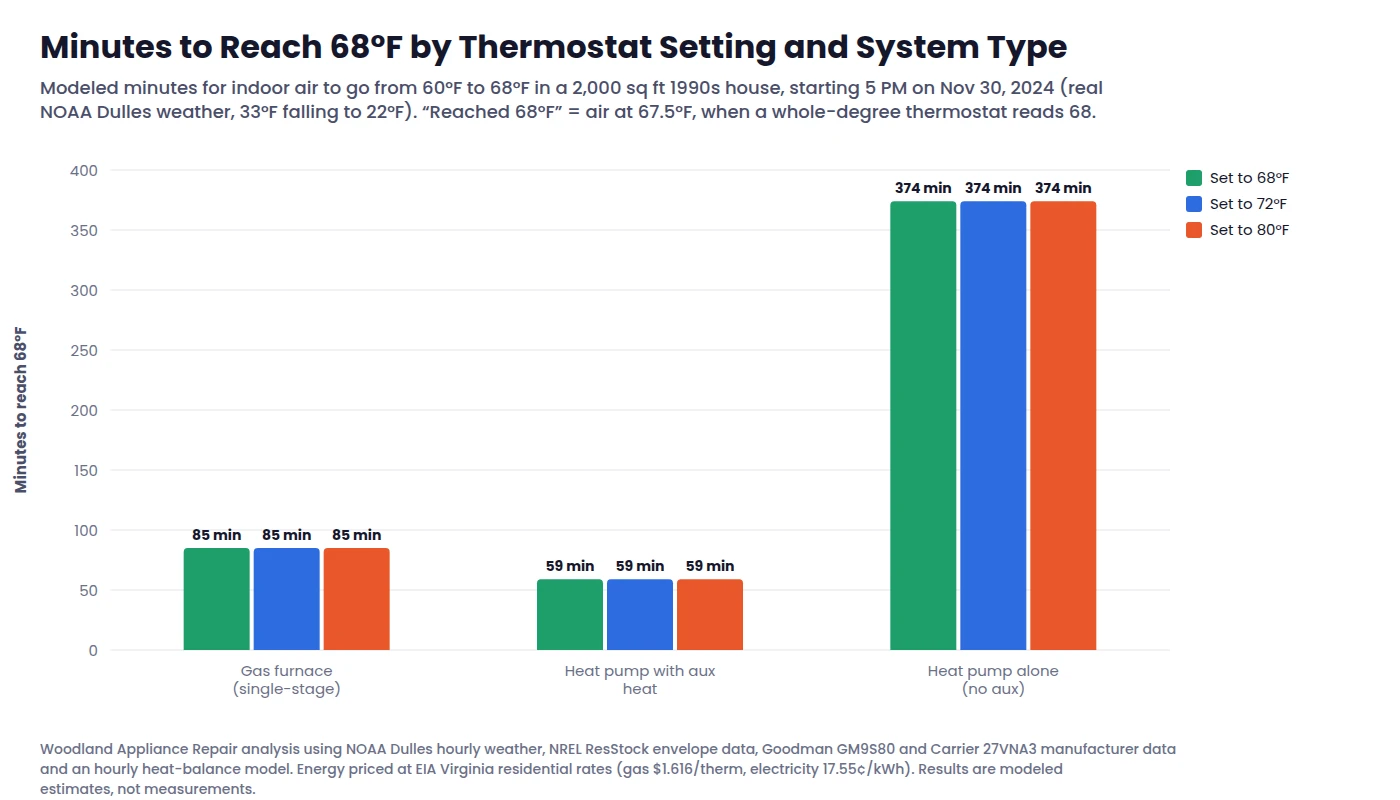
The furnace result is simple. A single-stage furnace has one speed: on. Whether the thermostat says 68 or 80, the burner delivers the same 64,000 Btu per hour until the thermostat is satisfied. DOE put it plainly decades ago: furnaces put out the same amount of heat no matter how high the thermostat is set, and only the running time changes. No setting can heat house faster than the burner’s one speed allows.
The heat pump result needs one more step. With our aux rule, aux heat comes on whenever the room is 2°F or more below the setting. Starting at 60°F, that’s true at 68, 72 and 80, so all three settings ran the compressor at full speed plus aux heat for the whole 59 minutes. The higher settings didn’t add any heat that 68 wasn’t already calling for.
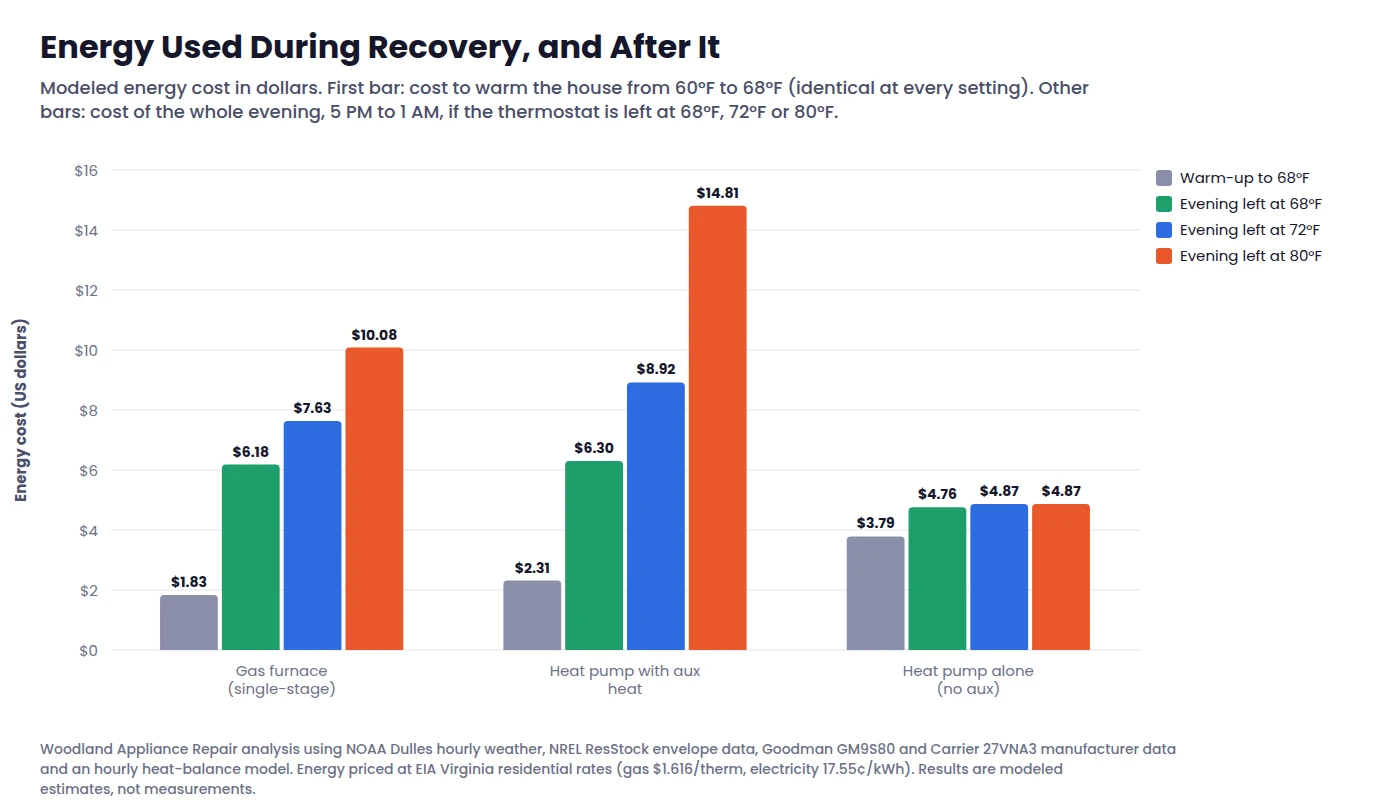
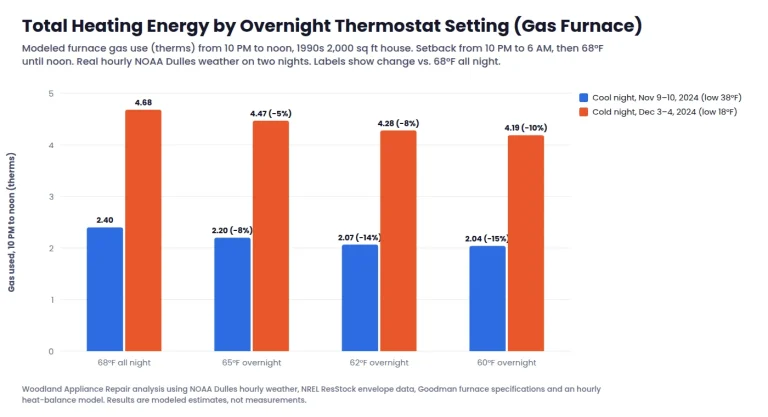
The second chart shows where the money goes. Reaching 68°F cost the same at every setting. The difference comes afterward, if the thermostat stays where you put it. Leaving the furnace at 80°F for the evening cost $10.08 instead of $6.18. For the heat pump, aux heat kept running toward 80°F all evening, and the cost jumped from $6.30 to $14.81.
When a higher setting can heat house faster: heat pumps
There’s one case where a bigger jump changes things. We reran the heat pump with the house at 66.5°F, just 1.5°F below 68. Set to 68°F, the room is inside the 2°F trigger, so the heat pump worked alone and reached 68°F in 9 minutes. Set to 72°F or 80°F, the gap was big enough to switch on aux heat, and it got there in 3 minutes.
So yes, on a heat pump a high setting can heat house faster by a few minutes, but only by turning on the most expensive heat in the system. Left at 80°F for the evening, that run cost $11.19, against $3.50 at 68°F. DOE advises against manual setbacks on a heat pump when they cause backup resistance heat to come on, and the same logic applies to big jumps upward.
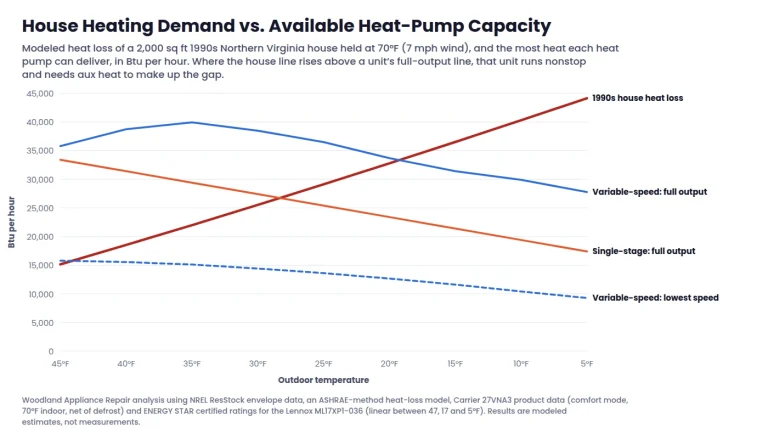
Without aux heat, the heat pump alone needed about 6.2 hours to warm the house from 60°F on this 22°F to 33°F evening. That’s why heat pumps come with aux heat, and why a smart thermostat with heat pump settings matters.
What this means for your home
- Gas furnace: set the temperature you actually want. Going higher doesn’t heat house faster; it just risks overshooting and paying for heat you didn’t want.
- Heat pump: a big jump on the thermostat will only heat house faster if it brings on aux heat, at a much higher cost. Raise it in small steps, or use a schedule.
- Plan ahead: the cheapest way to heat house faster is to start earlier. In our model, warming a 60°F house took more than an hour even with a properly sized furnace, because the walls and furniture soak up heat too. A schedule that starts an hour or two before you arrive beats any setting.
- Slow every time? If your system takes far longer than it used to, a dirty filter, a failing part or a thermostat problem could be the cause.
When your results could differ
- House age: with the 68°F setting, the furnace took about 64 minutes in a newer code-built house and about 120 minutes in a leaky 1970s house.
- Thermostat logic: many smart thermostats let you set the temperature gap and runtime that trigger aux heat. ecobee, for example, sets both to “auto” by default. Some use outdoor-temperature lockouts too. Your heat pump may behave differently from our 2°F rule.
- Two-stage and variable-speed furnaces: these can respond to a big temperature gap by firing harder, depending on their controls. We didn’t model them.
- Equipment size: our heat pump plus aux delivers more heat on this evening than our furnace, which is why it reached 68°F sooner. A different-sized system changes the order.
- Ducts and airflow: leaky ducts in an attic or crawl space, closed vents or a clogged filter all slow the warm-up.
Safety: heat the house with the heating system
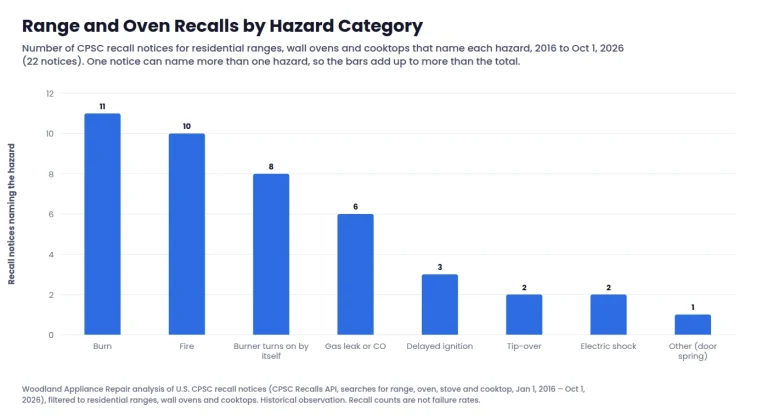
When the house is cold and the heat seems slow, don’t reach for the kitchen. The U.S. Fire Administration says to never use an oven to heat your home. CPSC recommends having a professional inspect furnaces and other fuel-burning heating systems each year, and putting carbon monoxide alarms on every level of the home and outside sleeping areas.
If your furnace or heat pump now takes much longer to warm the house than it used to, Woodland can help. Our furnace repair and heat pump repair visits start with a $69 service call, waived with the repair, and a flat quote before any work. If the problem is the thermostat or its aux settings, see our thermostat repair page. A $99 heating tune-up is a good way to catch slow-heating problems before the cold sets in.
House still slow to warm up?
We can usually be there the same day across Prince William and Fairfax counties. Use code FREECALL and the service call is free with your repair.
Heating repair in Northern Virginia
Early November is when slow-heating furnaces and heat pumps start showing up on our schedule. Woodland handles heating repair across Prince William, Fairfax, Loudoun and Fauquier counties, plus Arlington and Alexandria. We’re based in Woodbridge, so Woodbridge, Manassas, Dumfries and Lorton are usually same-day calls, and we’re in Fairfax, Centreville, Springfield, Arlington and Alexandria every week. See our heating repair page or call (703) 335-1009.
Sources and methodology
Methodology: we used a simplified heat-balance model rather than a full EnergyPlus simulation, so we could run real Dulles weather through the same house and change one thing at a time: the setting, then the system. The air and building mass both start at 60°F. The heat pump modulates between its lowest and full speed, and aux heat follows the 2°F rule above.
Sanity check: the furnace’s 64,000 Btu/h output is well above the house’s modeled heat loss on this evening (about 21,000 Btu/h at mid-recovery), and fully warming the air, walls and furniture by 8°F takes about 112,000 Btu, so a warm-up of one to two hours is consistent. Gas use to 68°F (1.13 therms in 85 minutes at 80,000 Btu/h input) matches the furnace rating. These are modeled estimates, not measurements of a real home.
- NOAA NCEI Global Hourly (Integrated Surface Database), Washington Dulles International Airport — hourly temperature and wind, Nov 30, 2024, 5 PM to 1 AM (historical observation)
- NREL ResStock housing characteristics, Virginia region — insulation, windows and air leakage for a 1990s house
- Goodman GM9S80 specification sheet (SS-GM9S80-U) — furnace input and output (manufacturer specification)
- Carrier, 27VNA3 Infinity Variable Speed Heat Pump Product Data — heat pump capacity and power (manufacturer specification)
- Carrier, FE5B Infinity Series Fan Coil Product Data — approved 10 kW electric heater
- ecobee, threshold settings for ecobee thermostats — compressor-to-aux temperature and runtime settings
- DOE/NREL fact sheet, Automatic and Programmable Thermostats (1997) — furnace output does not change with thermostat setting
- U.S. Department of Energy, Energy Saver Guide (2022) — heat pump setback and backup heat guidance
- U.S. EIA, Virginia natural gas residential price — Nov 2025–Jun 2026 average, converted at 1,037 Btu per cubic foot
- U.S. EIA, Electric Power Monthly, Table 5.6.A — Virginia residential electricity, July 2026
- U.S. Fire Administration, heating fire safety — never use an oven to heat your home
- CPSC, Keep Warm and Safe This Winter (2026) — annual heating inspection and CO alarm placement
- Model: two-node minute-by-minute heat balance with the LBL stack-and-wind infiltration model (ASHRAE Handbook of Fundamentals) — run by Woodland Appliance Repair
Safety note: Do not use an oven, range, grill, or other cooking appliance to heat a home. Heating-system behavior varies by equipment and control strategy.
Important Disclaimer
This article is for general educational purposes and is based on virtual testing, simulations, data analysis, published research, and the assumptions described in the article unless a physical test is specifically stated. Results are estimates and may differ based on your home, equipment, installation, maintenance, weather, usage, and other conditions. Do not recreate unsafe conditions or rely on these results as a substitute for manufacturer instructions, official safety guidance, or advice from a qualified professional. Woodland Appliance Repair, LLC makes no guarantee that these results will apply to your specific situation and disclaims warranties and liability to the fullest extent permitted by law.
Need a repair? We can usually be there today.
Locally owned and operated in Woodbridge. Licensed & insured, EPA 608 certified, with 15+ years fixing appliances, heating and cooling across Northern Virginia. $69 service call, free with the repair.