Haven’t Changed Your Furnace Filter Since Spring? We Tested How Restricted Airflow Changes Heating Performance
Quick answer
A dirty furnace filter reduces airflow, but in our model the drop was small until the filter was heavily loaded. For a common 80,000 Btu/h Goodman furnace with a 1-inch MERV 8 filter, 25% and 50% more filter resistance cut airflow by only about 2% and 4%. A badly restricted filter, about 2.6 times its clean resistance, pushed total static pressure from 0.50 to 0.80 inches of water, cut airflow 11% and raised the furnace’s temperature rise from 48°F to 54°F. How fast your filter gets there depends on your home.
The first cold morning arrives, the heat kicks on, and you remember the furnace filter hasn’t been touched since spring. Is it quietly choking the system, or is it fine for a few more weeks? And what does a dirty furnace filter actually change inside the furnace?
We tested it virtually, not in a basement. This is a calculated model, not a physical test: we combined the furnace maker’s published blower table with a filter maker’s published pressure-drop data and solved for the airflow at each filter condition. No real furnace was restricted. Every result below is a calculated estimate.
What we tested
One furnace, one blower setting, one duct system and one filter size. Only the filter’s resistance to airflow changes.
- Furnace: Goodman GM9S800805CU, 80,000 Btu/h input, 64,000 Btu/h output, at its default heat speed (tap F02), with a lower speed (tap F01) as a second case
- Filter: a standard 1-inch MERV 8 pleated filter, 20×25, in the bottom return
- Filter conditions: clean, 25% more resistance, 50% more resistance, high restriction (2.6 times clean) and very high (3.6 times clean)
- Calculated: static pressure, delivered airflow (CFM) and temperature rise compared with the furnace’s listed 35–65°F range
- Result type: calculated estimates from manufacturer data, not measurements
How we modeled a dirty furnace filter
A furnace blower pushes air against resistance from the filter, the return and supply ducts, the coil and the registers. The more resistance, the higher the static pressure and the less air the blower can move. The manufacturer publishes exactly how much air this furnace moves at each static pressure, so we matched that against the resistance of the house’s air path.
| Input | Value used | Source |
|---|---|---|
| Blower table, default heat speed (F02) | 1,401 CFM at 0.1 in. w.c. down to 1,099 CFM at 0.8 in. | Goodman specification sheet |
| Furnace output and listed rise | 64,000 Btu/h; 35–65°F temperature rise | Goodman specification sheet |
| Clean filter resistance | 0.23 in. at 300 ft/min, 0.42 in. at 500 ft/min (1-inch MERV 8) | AAF Flanders product data, ASHRAE 52.2 basis |
| Filter rating area | 3.5 sq ft for a 20x25x1 (1,050 CFM at 300 ft/min) | AAF Flanders product data |
| Design static pressure | 0.5 in. w.c. total with a clean filter | PNNL Building America guidance |
| Loaded filter | Clean resistance × 1.25, 1.5, 2.6 or 3.6 at the same airflow | Test scenarios (not filter ages) |
We sized the ducts so the whole system reaches 0.5 inches of water column with a clean filter at the default heat speed. PNNL says most home systems run efficiently at a total of no more than 0.4 or 0.5 in. At that point the clean filter takes 0.28 in. and the ducts, coil and registers take 0.22 in.
The filter’s resistance rises with air speed, following the curve through AAF’s two published points. The “high restriction” case is the most restriction this furnace can handle while staying inside Goodman’s published table (0.8 in.). The “very high” case puts the filter at AAF’s 1.0-inch recommended final resistance. It runs past the end of the table, so those numbers are a straight-line extension and less certain.
Results: a dirty furnace filter vs. a clean one
Default heat speed, same blower setting and ducts in every row:
| Filter condition | Filter resistance | Total static | Airflow | Change | Temperature rise |
|---|---|---|---|---|---|
| Clean | 0.28 in. | 0.50 in. | 1,234 CFM | Baseline | 48°F |
| 25% more resistance | 0.34 in. | 0.55 in. | 1,211 CFM | −1.9% | 49°F |
| 50% more resistance | 0.40 in. | 0.60 in. | 1,188 CFM | −3.7% | 50°F |
| High restriction (2.6× clean) | 0.62 in. | 0.80 in. | 1,099 CFM | −10.9% | 54°F |
| Very high (3.6× clean)* | 0.80 in. | 0.96 in. | About 1,030 CFM | About −17% | About 58°F |
*Beyond the manufacturer’s table; extended in a straight line from its last two points.
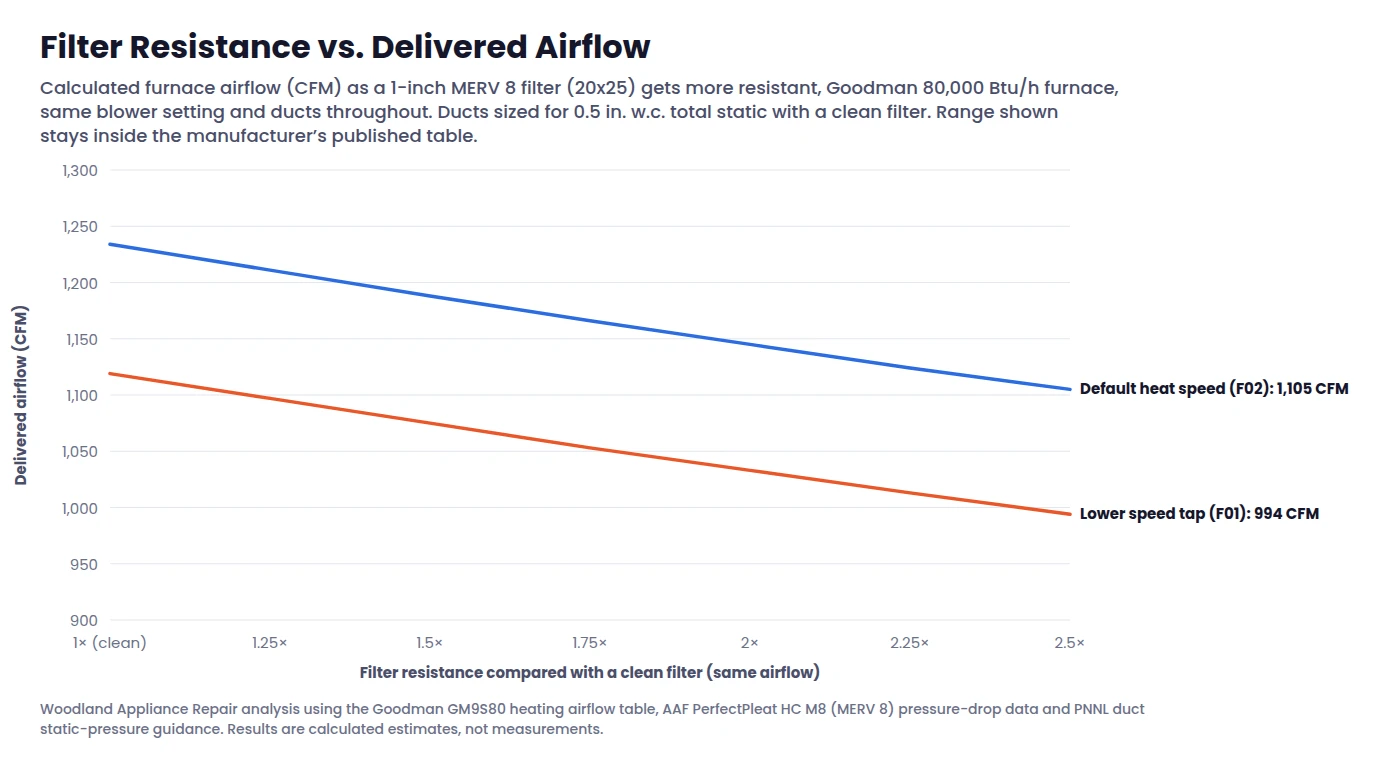
The airflow curve is gentler than many people expect. This furnace has a variable-speed ECM blower motor, and PNNL notes that ECM motors “will not fall off like a PSC motor” as resistance rises. Even so, a heavily loaded filter cost 135 CFM at the default heat speed and 130 CFM on the lower speed. On the lower speed, the clean system started at 1,119 CFM and fell to 989 CFM at 2.6 times clean resistance.
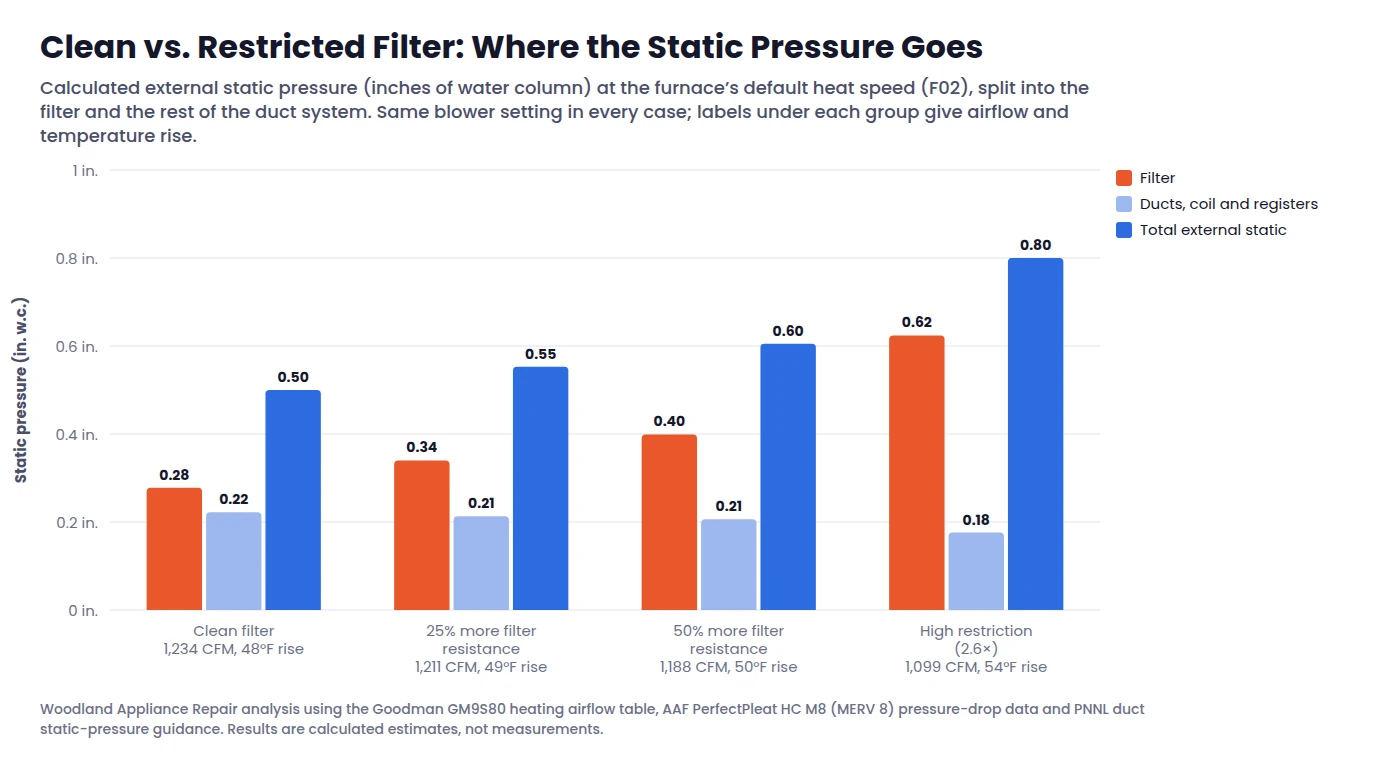
The second chart shows where the blower’s push goes. With a clean filter, the filter uses about 56% of the total static pressure. At high restriction it uses 78%, total static climbs from 0.50 to 0.80 in., and the ducts actually see less pressure because less air is moving through them. That’s the airflow problem a dirty furnace filter creates: the blower spends more of its effort pulling air through the filter and less moving heat through your house.
What a dirty furnace filter changes during heating
The burners make the same heat no matter how dirty the filter is. With less air carrying that heat, the air leaving the furnace gets hotter. That’s the temperature rise, and Goodman lists 35°F to 65°F as the allowed range for this furnace.
At the default heat speed, the rise went from 48°F clean to 54°F at high restriction, and about 58°F in the very high case. That’s still inside the listed range. On the lower blower speed, the same filter conditions took the rise from 53°F to 60°F, and the very high case reached about 64°F, right at the top of the range. So the same dirty furnace filter can be a minor issue on one setup and a real one on another.
We didn’t calculate blower power, run time or equipment life. The blower table doesn’t include power, and there’s no reliable data to turn airflow into years of furnace life. The DOE says a dirty or clogged filter “can dramatically reduce air flow, increasing furnace run time, wear on the motor and energy consumption,” and ENERGY STAR warns it can increase energy costs and lead to early equipment failure. Those are their findings, not results of our calculation.
How dirty is too dirty? It depends on the house
We deliberately didn’t label any scenario “three months” or “six months.” A field study by Lawrence Berkeley National Laboratory found that filter loading rates “varied more from house to house more than by MERV rating, and overall were quite low in many of the homes.” So a dirty furnace filter in one home can look nothing like one of the same age next door. The same LBNL study found new 1-inch filters in real homes already averaged 0.44 in. of resistance, higher than our clean filter, so many systems start closer to the limit than our example.
What this means for your home
- Check it monthly in heating season. ENERGY STAR recommends inspecting, cleaning or changing filters once a month. Replace it when it’s visibly loaded, or sooner if your filter maker says so.
- A slightly dirty furnace filter isn’t an emergency. In our calculation, modest loading changed airflow by only a few percent.
- A heavily loaded dirty furnace filter is a real airflow problem. At 2.6 times clean resistance, airflow fell 11% and the air leaving the furnace ran about 6°F hotter.
- A clean filter doesn’t fix everything. If rooms stay cold or airflow is weak with a new filter, the ducts, blower setting or coil may be the restriction. A technician can measure static pressure and temperature rise directly.
When your results could differ
- Older PSC blower motors lose airflow faster as static pressure rises than this ECM blower does.
- Thicker or different filters: a 2-inch filter of the same type has about half the resistance; higher-MERV filters can have more.
- Smaller ducts: a system already above 0.5 in. with a clean filter has less room before a dirty furnace filter cuts airflow.
- Two side filters: this furnace can also use two 16×25 filters on side returns, which spreads the air over more filter area.
- Cooling season: the blower runs faster for air conditioning, so the same filter adds more resistance in summer.
Filter safety
Never run a furnace without its filter to “get more air.” The filter protects the blower, coil and heat exchanger from dust. Use the size and type your furnace manual lists, and install it so the airflow arrow points the way your manual shows. If your furnace shuts off before the house warms up, short-cycles, or smells hot after a filter change, turn it off and have it checked. Our furnace repair technicians can measure static pressure and temperature rise, and a $99 heating tune-up before winter is a good time to have airflow looked at. Heat pump owners can see our heat pump repair page.
Weak airflow even after a filter change?
We can usually be there the same day across Prince William and Fairfax counties. Use code FREECALL and the service call is free with your repair.
From our technician
“What I like finding on a fall tune-up are parts that still work but are starting to show trouble: a weak igniter, a dirty flame sensor, a capacitor getting weak, a loose electrical connection, a condensate line starting to plug up, a burner issue or something questionable with the venting.
Those are exactly the things you want to find in October instead of after the furnace quits on a 20-degree night.”
Nick, Senior Technician, EPA-certified, experience since 2008
Furnace repair in Northern Virginia
Airflow problems that a new filter doesn’t fix are one of the most common heating calls we see in the fall. Woodland handles furnace repair across Prince William, Fairfax, Loudoun and Fauquier counties, plus Arlington and Alexandria. We’re based in Woodbridge, so Woodbridge, Manassas, Dumfries and Lorton are usually same-day calls, and we’re in Fairfax, Centreville, Springfield, Arlington and Alexandria every week. See our furnace repair page or call (703) 335-1009.
Sources and methodology
Methodology: we found the point where the furnace blower’s published airflow curve meets the resistance of the air path. The air path is the filter plus a duct system whose resistance rises with the square of airflow, sized to 0.5 in. w.c. total at 1,234 CFM with a clean filter. Filter resistance follows a power curve through AAF’s two published points (exponent 1.18). Loaded-filter cases multiply the clean resistance at the same air speed.
Temperature rise = furnace output ÷ (1.08 × CFM), which matches Goodman’s printed 48°F rise at 0.5 in. The very high case runs beyond the 0.8 in. end of Goodman’s table and is extrapolated. These are calculated estimates for one furnace, filter and duct system, not measurements.
- Goodman GM9S80 specification sheet (SS-GM9S80-U) — heating airflow table, output and 35–65°F rise range (manufacturer specification)
- AAF Flanders PerfectPleat HC M8 product sheet — clean resistance, rated airflow and 1.0 in. final resistance (manufacturer specification)
- PNNL Building America Solution Center, High-MERV Filters — 0.4–0.5 in. total static guidance; ECM vs PSC motors
- Walker et al., System Effects of High Efficiency Filters in Homes, LBNL-6144E (2013) — field-measured filter resistance and loading (published measurement)
- U.S. DOE Building Science Education, HVAC proper installation of filters — effect of dirty filters
- ENERGY STAR maintenance checklist — monthly filter inspection
Safety note: Do not intentionally block airflow, operate a forced-air HVAC system without its required filter, or use a filter outside the equipment manufacturer’s specifications to recreate this test.
Important Disclaimer
This article is for general educational purposes and is based on virtual testing, simulations, data analysis, published research, and the assumptions described in the article unless a physical test is specifically stated. Results are estimates and may differ based on your home, equipment, installation, maintenance, weather, usage, and other conditions. Do not recreate unsafe conditions or rely on these results as a substitute for manufacturer instructions, official safety guidance, or advice from a qualified professional. Woodland Appliance Repair, LLC makes no guarantee that these results will apply to your specific situation and disclaims warranties and liability to the fullest extent permitted by law.
Need a repair? We can usually be there today.
Locally owned and operated in Woodbridge. Licensed & insured, EPA 608 certified, with 15+ years fixing appliances, heating and cooling across Northern Virginia. $69 service call, free with the repair.