Trying to Hold Off on Turning On the Heat? We Tested How Cold Your House Gets Overnight
Quick answer
Turn on the heat once nights drop into the 30s. In our model, a 2,000 sq ft house that started at 70°F with the heat off fell to between 56°F and 62°F by 7 AM on a 32°F night in Northern Virginia, depending on its age. On a mild night with a low in the mid-50s, the same houses lost only 2–4°F, so you can usually hold off a little longer.
It’s the first chilly week of October. The house feels a little cool at bedtime, the thermostat still says “off,” and you’re wondering whether you can make it through one more night before you turn on the heat for the season. How cold will it really get by morning?
We tested it, virtually. This is a computer simulation, not a measurement in a real home: we built an hour-by-hour heat model of three typical Northern Virginia houses and ran each one through three real fall nights recorded at Washington Dulles International Airport. Here’s what happened with the heat off from 10 PM to 7 AM.
What we tested
Three 2,000 sq ft detached houses start at 70°F at 10 PM. The heat stays off until 7 AM. We ran each house through three real nights of NOAA Dulles weather.
- Houses: a 1970s house, a 1990s house and a newer house built to current Virginia code, using typical insulation, windows and air leakage for each era
- Nights: mild (Oct 23–24, 2024, low 54°F), cool (Oct 21–22, 2024, low 45°F) and the first truly cold one (Oct 27–28, 2024, low 32°F)
- Measured in the model: indoor temperature every hour, the lowest temperature by 7 AM, and hours until the house reached 68°F, 65°F and 60°F
- Result type: modeled estimates, not measurements
How we ran the overnight test
Each house is a two-story, 2,000 sq ft detached home with a 1,000 sq ft footprint, 8-foot ceilings and windows on about 15% of its walls. Only the construction changes between the three houses:
| House | Wall insulation | Attic | Windows | Air leakage |
|---|---|---|---|---|
| 1970s house | R-8.7 (effective) | R-31.6 | Double-pane, U-0.49 | 20 ACH50 (leaky) |
| 1990s house | R-10.3 | R-31.6 | Double-pane, U-0.49 | 10 ACH50 |
| Newer code-built house | R-12.1 | R-39.6 | Low-e, U-0.32 | 5 ACH50 (tight) |
The insulation and window values are the most common options for Virginia homes of each era in NREL’s ResStock housing database. The air-leakage values come from the same database for the older houses and from Virginia’s current code limit for the newer one. ACH50 is a blower-door number: how many times the house’s air would leak out in an hour under a strong test pressure. Lower means tighter.
The model tracks two things hour by hour: how fast heat escapes through walls, attic, windows and leaks, and how much heat is stored in the air, drywall, framing and furniture. Air leakage changes with the indoor-outdoor temperature difference and the real wind speed at Dulles that night. We counted 1,500 Btu per hour of heat from the fridge, electronics and sleeping people, and no sunshine, since it’s dark. The full list of assumptions is in the sources section at the end.
Results: how cold each house got with the heat off
All nine runs start at 70°F at 10 PM. “Not reached” means the house never got that cold by 7 AM.
| Night (Dulles low) | House | Temp at 7 AM | Hours to 68°F | Hours to 65°F | Hours to 60°F |
|---|---|---|---|---|---|
| Mild (54°F) | 1970s | 66.4°F | 3.4 h | Not reached | Not reached |
| Mild (54°F) | 1990s | 67.2°F | 6.5 h | Not reached | Not reached |
| Mild (54°F) | Newer | 68.1°F | Not reached | Not reached | Not reached |
| Cool (45°F) | 1970s | 62.3°F | 1.7 h | 5.5 h | Not reached |
| Cool (45°F) | 1990s | 63.7°F | 2.3 h | 7.0 h | Not reached |
| Cool (45°F) | Newer | 65.5°F | 3.7 h | Not reached | Not reached |
| Cold (32°F) | 1970s | 56.5°F | 0.6 h | 2.3 h | 6.1 h |
| Cold (32°F) | 1990s | 59.1°F | 0.8 h | 3.4 h | 8.1 h |
| Cold (32°F) | Newer | 62.1°F | 1.5 h | 5.2 h | Not reached |
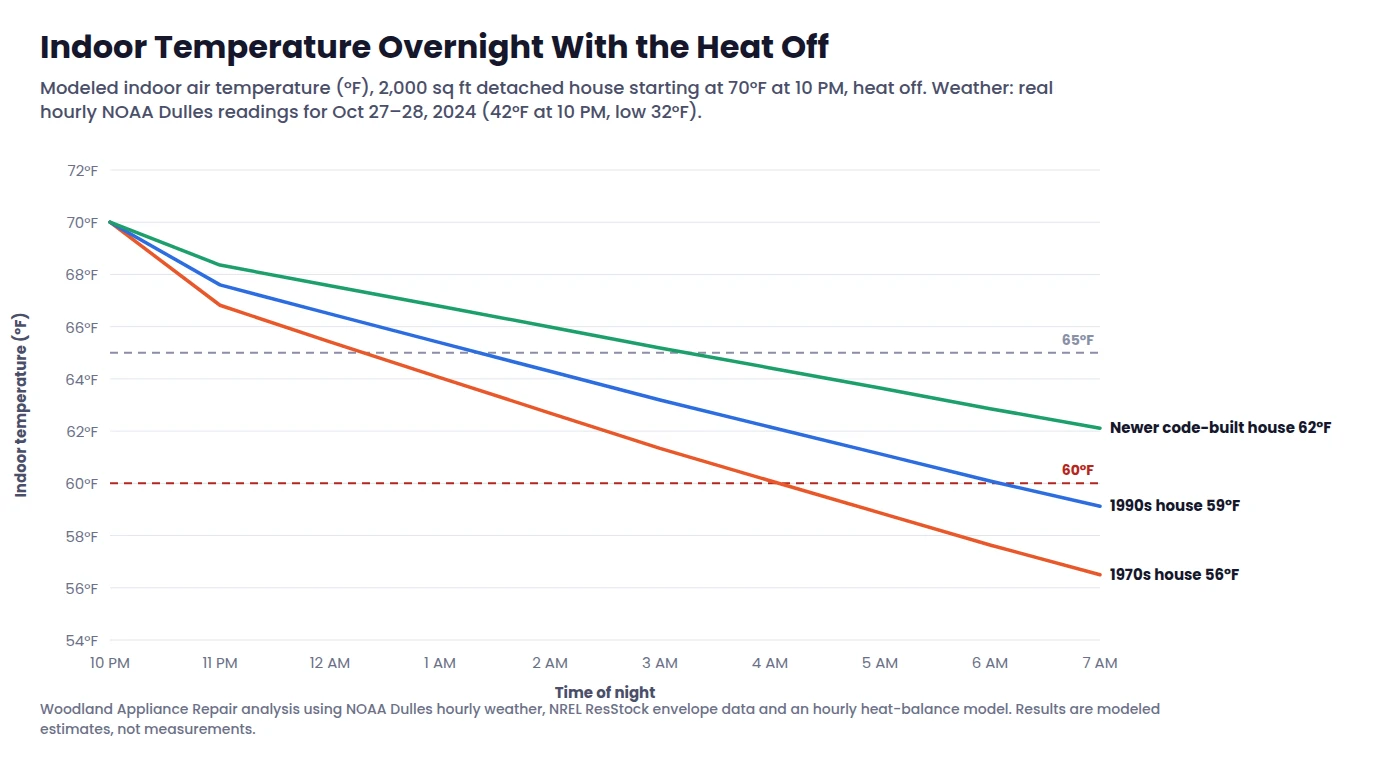
On the coldest night the gap between houses is easy to see. The 1970s house dropped below 65°F about 12:20 AM and below 60°F just after 4 AM. The 1990s house crossed 60°F around 6 AM. The newer house never got below 62°F. In all three, the first hour was the steepest, because the warm air cools quickly before the slower-to-cool walls, floors and furniture start giving back their stored heat.
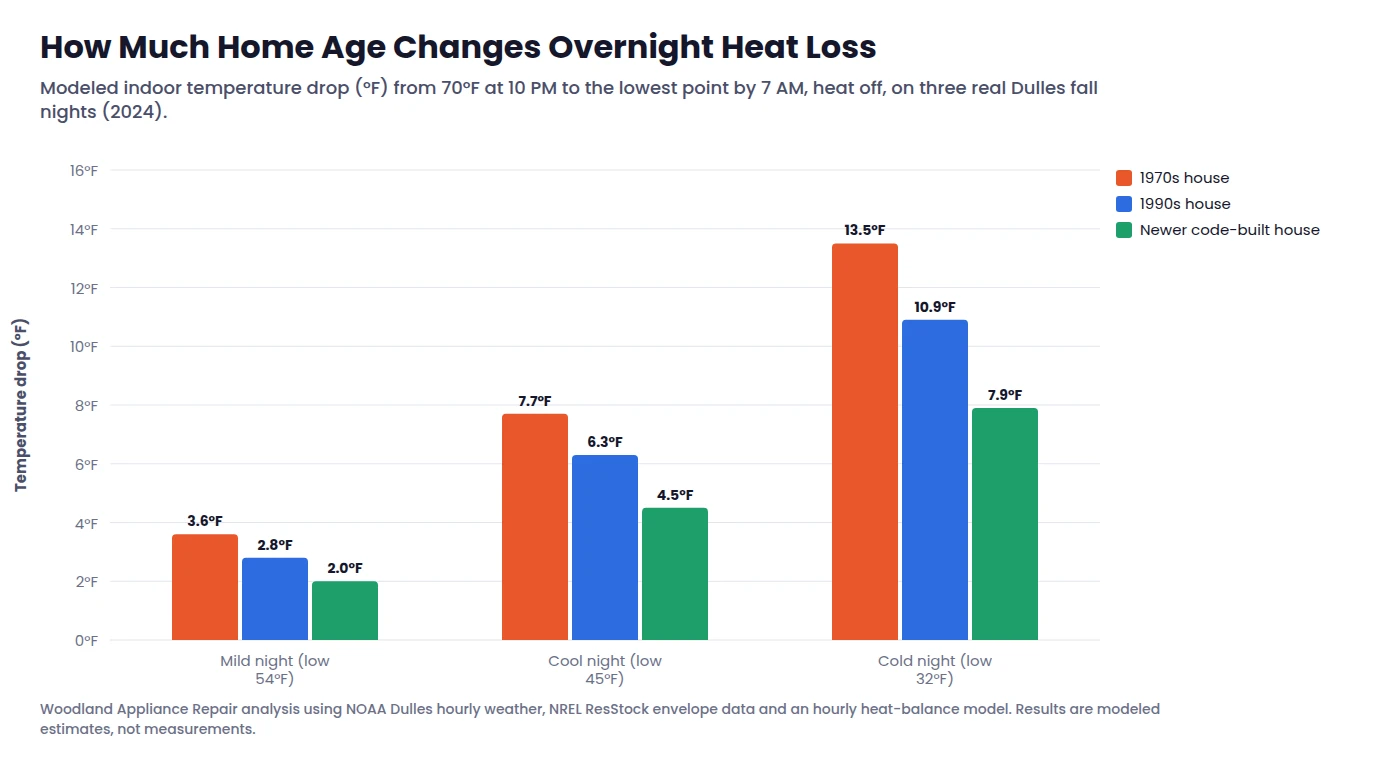
The second chart shows how much the weather matters. On the mild night, every house lost less than 4°F, and the newer house barely lost 2°F. On the cool night, the drop roughly doubled. On the 32°F night, the 1970s house lost 13.5°F, nearly twice as much as the newer house.
Why some houses cool faster than others
If you’re trying to decide when to turn on the heat, it helps to know what drives the overnight drop. There are two big factors.
A house loses heat in proportion to the difference between inside and outside. A 54°F night pulls heat out slowly; a 32°F night pulls about two and a half times as hard. That’s why the drop isn’t a fixed number of degrees per hour. It depends on the night.
The age of the house decides how easily that heat gets out. In our model, the biggest single difference between the 1970s and newer houses is air leakage: the older house trades its warm air for cold outdoor air about four times as fast. Better windows and more attic insulation add to the gap.
What this means for your home
- Mild nights (lows in the 50s): most houses lose only a few degrees overnight. Whether to turn on the heat is a comfort choice, not a problem.
- Cool nights (lows in the 40s): expect to wake up somewhere in the low-to-mid 60s. Many people decide to turn on the heat here, often on a low setting.
- The first night in the low 30s: an older house can fall into the 50s by morning. This is the point where we’d turn on the heat, even if it’s set low.
- Pipes: none of these fall nights came close to freezing indoors, but pipes in crawl spaces, garages or exterior walls are much colder than the living room. Don’t use the living-room temperature as a pipe-safety reading.
In Northern Virginia, that first freezing night comes earlier than many people expect. Over the last 10 years, Dulles recorded its first fall low of 32°F or colder between October 21 and November 10, so late October is when the question of when to turn on the heat gets real.
When your house could cool faster or slower
- Wind: two of our three nights were calm. On a windy night, a leaky house loses heat noticeably faster.
- Size and shape: a townhouse with heated neighbors on both sides cools much more slowly. A rambler with a big attic or a house over a vented crawl space can cool faster.
- Basements and slabs: we used one simple floor-loss value. A finished basement can hold the house warmer; an uninsulated crawl space can do the opposite.
- Sun and windows: overnight there’s no sun, but a house that soaked up afternoon sun starts the night with more stored heat than our 70°F starting point.
- Renovations: a 1970s house with new windows, attic insulation and air sealing can behave more like our 1990s or newer house.
Before you turn on the heat for the first time
The first time you turn on the heat each fall, the furnace has been sitting idle for months. A burning-dust smell for the first few minutes is common. A smell that doesn’t fade, a burner that clicks but won’t light, or a blower that runs cold air are signs to have it checked. Our furnace repair and heat pump repair pages cover the most common first-start problems, and a $99 heating tune-up before the first cold night catches most of them early.
Make sure your carbon monoxide alarms work before you turn on the heat with a gas furnace. Test them and replace batteries if needed.
Heat not coming on the first cold night?
We can usually be there the same day across Prince William and Fairfax counties. Use code FREECALL and the service call is free with your repair.
From our technician
We asked Nick when people in Northern Virginia turn on the heat, and when the calls start.
“I’d put the first noticeable jump in furnace calls around the second half of October. That’s when people who hadn’t really run the furnace yet start turning it on overnight. When we get down around freezing toward the end of October, it jumps again, because now the system is running for real.
On a mild fall day we’re looking at around 3 to 5 heating calls. During the first real cold snap, that can easily double.”
Nick, Senior Technician, EPA-certified, experience since 2008
Heating repair in Northern Virginia
The first cold nights of October are when we see the most furnaces that won’t start after a long summer off. Woodland handles heating repair across Prince William, Fairfax, Loudoun and Fauquier counties, plus Arlington and Alexandria. We’re based in Woodbridge, so Woodbridge, Manassas, Dumfries and Lorton are usually same-day calls, and we’re in Fairfax, Centreville, Springfield, Arlington and Alexandria every week. See our heating repair page or call (703) 335-1009.
Sources and methodology
Methodology: we used a simplified hourly heat-balance model rather than a full EnergyPlus simulation, so we could run real Dulles weather through the same house quickly and change one thing at a time (home age or weather).
Assumptions: 2,000 sq ft two-story detached house, 1,000 sq ft footprint, 15% window-to-wall ratio, 8-ft ceilings; foundation losses to 50°F ground; 1,500 Btu/h of internal heat; no solar gain; heat stored in air and furnishings (1 Btu/°F per sq ft) and in slower building mass (6 Btu/°F per sq ft).
Sanity check: the model’s design heat loss at 14°F outdoors is about 54,000 Btu/h for the 1970s house, 37,000 for the 1990s house and 24,000 for the newer house, in the normal range for a house this size. These are modeled estimates, not measurements of real homes.
- NOAA NCEI Global Hourly (Integrated Surface Database), Washington Dulles International Airport — hourly temperature and wind for Oct 21–22, 23–24 and 27–28, 2024 (historical observation)
- NOAA GHCN-Daily, Dulles (USW00093738) — first fall 32°F lows, 2016–2025 (historical observation)
- NREL ResStock housing characteristics, Virginia region — wall and attic insulation, windows and air leakage by era
- PNNL Building America Solution Center, IECC insulation and window requirements — newer-house envelope
- American Red Cross, preventing frozen pipes — pipe-protection guidance
- Model: two-node hourly heat balance with the LBL stack-and-wind infiltration model (ASHRAE Handbook of Fundamentals) — run by Woodland Appliance Repair
Safety note: This simulation is not a recommendation to leave your heating system off during cold weather. Indoor temperatures and freeze risks vary substantially by home, plumbing location, insulation, weather, and occupant needs.
Important Disclaimer
This article is for general educational purposes and is based on virtual testing, simulations, data analysis, published research, and the assumptions described in the article unless a physical test is specifically stated. Results are estimates and may differ based on your home, equipment, installation, maintenance, weather, usage, and other conditions. Do not recreate unsafe conditions or rely on these results as a substitute for manufacturer instructions, official safety guidance, or advice from a qualified professional. Woodland Appliance Repair, LLC makes no guarantee that these results will apply to your specific situation and disclaims warranties and liability to the fullest extent permitted by law.
Need a repair? We can usually be there today.
Locally owned and operated in Woodbridge. Licensed & insured, EPA 608 certified, with 15+ years fixing appliances, heating and cooling across Northern Virginia. $69 service call, free with the repair.