Trying to Save on Heating While You Sleep? We Tested 4 Thermostat Settings to See What Actually Saves
Quick answer
The best night thermostat setting for saving money depends on your heating system. In our computer model of a Northern Virginia home, a gas furnace saved the most at the lowest setting tested: turning down from 68°F to 60°F from 10 PM to 6 AM used 15% less gas on a cool November night and 10.5% less on an 18°F December night, even after reheating the house in the morning. A heat pump was different. A small setback to 65°F saved a little or broke even, but 62°F and 60°F cost 12% to 19% more on the cold night when backup strip heat helped the morning warm-up.
It’s a chilly fall evening in Northern Virginia, and your hand stops at the thermostat on the way to bed. Turning it down should save money, but you’ve heard the furnace just burns it all back in the morning. So which night thermostat setting actually saves, and by how much?
We tested it, virtually. This is a computer simulation, not a measurement in a real house. We built an hour-by-hour heat model of a typical 1990s home and ran it through two real nights of weather recorded at Washington Dulles International Airport, once with a gas furnace and once with a heat pump. Heating season is starting, so now is a good time to pick a night thermostat setting.
What we tested
One 1990s house, four thermostat schedules, two real nights and two heating systems. The furnace and the heat pump were run separately and are never combined.
- Settings: 68°F all night (the control), or 65°F, 62°F or 60°F from 10 PM to 6 AM, then back to 68°F at 6 AM and held until noon
- Nights: a cool night (Nov 9–10, 2024, low 38°F) and a cold one (Dec 3–4, 2024, low 18°F), using hourly NOAA temperature and wind at Dulles
- Systems: a single-stage gas furnace, and a variable-speed heat pump with 10 kW of backup strip heat, run with and without the strip heat allowed
- Measured in the model: overnight and morning energy, the 14-hour total, time back to 68°F, cost, and change vs. 68°F all night
- Result type: modeled estimates, not measurements
How we ran the night thermostat setting test
The house is a two-story, 2,000 sq ft detached home with typical 1990s Virginia construction. The model tracks heat leaving through walls, attic, windows, floor and air leaks every minute, plus the heat stored in the air, drywall, framing and furniture.
| Input | Value used | Where it comes from |
|---|---|---|
| House | 2,000 sq ft, two stories, 1990s construction | NREL ResStock (Virginia homes) |
| Insulation and windows | R-10.3 walls (effective), R-31.6 attic, double-pane windows (U-0.49) | NREL ResStock |
| Air leakage | 10 ACH50 (blower-door air changes per hour) | NREL ResStock, from LBNL field data |
| Gas furnace | Goodman GM9S800805CU: 80,000 Btu/h in, 64,000 Btu/h out, 80% AFUE, single stage | Manufacturer specification |
| Heat pump | Carrier Infinity 27VNA336, variable speed, capacity net of defrost | Manufacturer product data |
| Backup strip heat | 10 kW electric heater, 1 kWh in for 1 kWh of heat | Carrier approved heater list |
| Gas price | $1.616 per therm | EIA, Virginia residential, Nov 2025–Jun 2026 average |
| Electricity price | 17.55¢ per kWh | EIA, Virginia residential, July 2026 |
The furnace turns on half a degree below the set point and off half a degree above it, always at full fire. The heat pump speeds up and slows down between the minimum and maximum output in Carrier’s published tables.
Backup strip heat is where thermostats differ most. Our assumed rule: strip heat turns on when the room is 2°F or more below the set point and off within half a degree. Because real controls vary, we also ran every heat pump case with strip heat never allowed. Only the night thermostat setting changed between runs.
Results: furnace vs. heat pump
Each run covers 10 PM to noon. “Back near 68°F” is when the room got within half a degree of 68°F after the 6 AM change. Gas furnace first:
| Night (Dulles low) | Setting | Gas used | Cost | vs. 68°F all night | Back near 68°F |
|---|---|---|---|---|---|
| Cool (38°F) | 68°F all night | 2.40 therms | $3.88 | Control | n/a |
| Cool (38°F) | 65°F | 2.20 therms | $3.56 | −8.3% | 6:09 AM |
| Cool (38°F) | 62°F | 2.07 therms | $3.34 | −13.9% | 6:31 AM |
| Cool (38°F) | 60°F | 2.04 therms | $3.30 | −15.0% | 6:45 AM |
| Cold (18°F) | 68°F all night | 4.68 therms | $7.56 | Control | n/a |
| Cold (18°F) | 65°F | 4.47 therms | $7.22 | −4.6% | 6:13 AM |
| Cold (18°F) | 62°F | 4.28 therms | $6.92 | −8.5% | 7:10 AM |
| Cold (18°F) | 60°F | 4.19 therms | $6.77 | −10.5% | 7:45 AM |
The heat pump results, same house, nights and schedules, are in electricity cost:
| Night | Setting | Heat pump, strip heat allowed | Heat pump only | Heat pump only, back near 68°F |
|---|---|---|---|---|
| Cool | 68°F all night | 15.3 kWh, $2.68 | 15.3 kWh, $2.68 | n/a |
| Cool | 65°F | $2.59 (−3.5%) | $2.46 (−8.4%) | 6:21 AM |
| Cool | 62°F | $2.69 (+0.5%) | $2.25 (−15.9%) | 7:54 AM |
| Cool | 60°F | $2.96 (+10.5%) | $2.16 (−19.5%) | 8:43 AM |
| Cold | 68°F all night | 36.1 kWh, $6.33 | 36.1 kWh, $6.33 | n/a |
| Cold | 65°F | $6.39 (+0.9%) | $5.93 (−6.3%) | 9:10 AM |
| Cold | 62°F | $7.11 (+12.3%) | $5.35 (−15.5%) | 11:09 AM |
| Cold | 60°F | $7.52 (+18.8%) | $4.83 (−23.7%) | Not by noon (67.2°F) |
Which night thermostat setting saves the most with a gas furnace
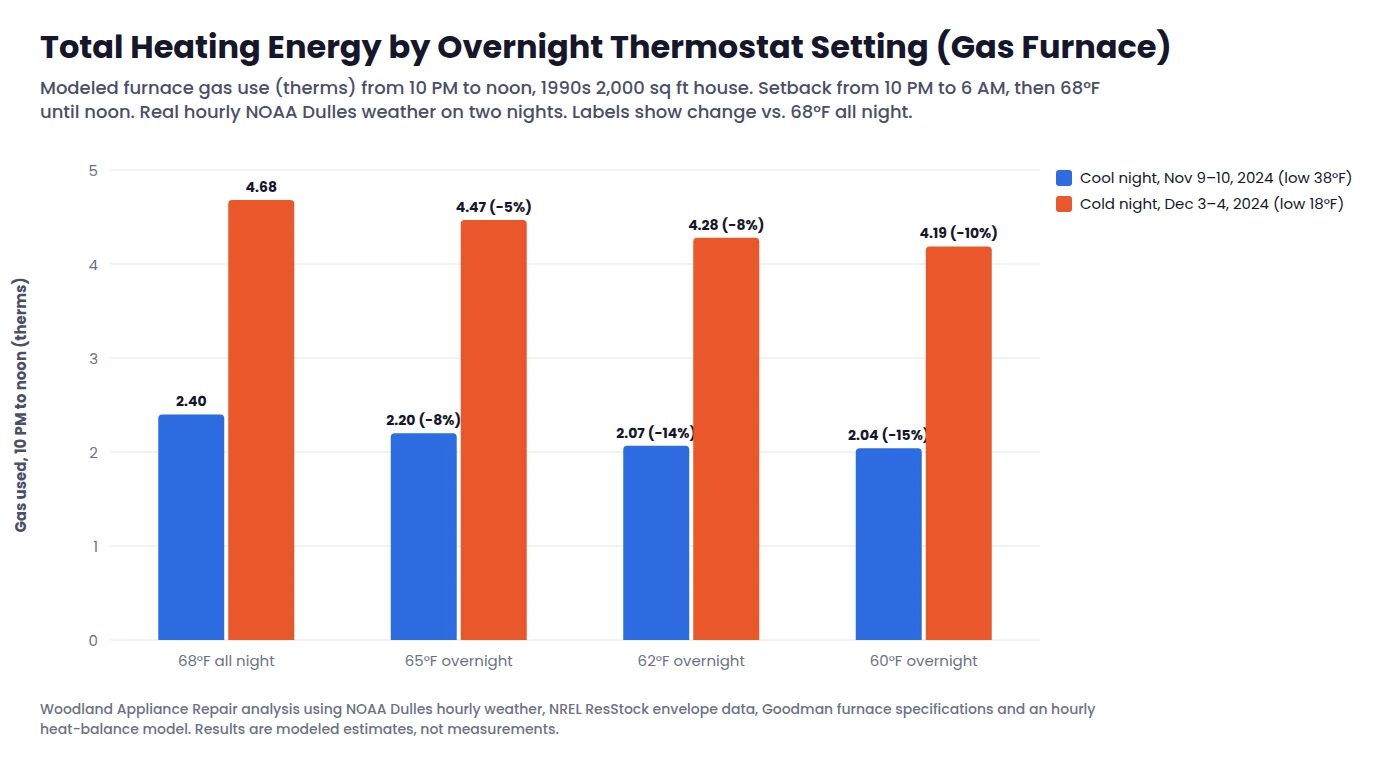
With the furnace, the answer was simple: the lower the night thermostat setting, the less gas the house used, on both nights. On the cool night the house bottomed out at 60.3°F, so the 60°F and 62°F results are close. On the cold night, each extra degree kept saving.
In dollars, the savings were modest: $0.32 to $0.58 on the cool night and $0.34 to $0.79 on the cold night at the current Virginia gas price. The furnace recovered quickly too. Even from 60°F on the 18°F night, the room was back near 68°F by 7:45 AM.
Does reheating the house cancel the savings?
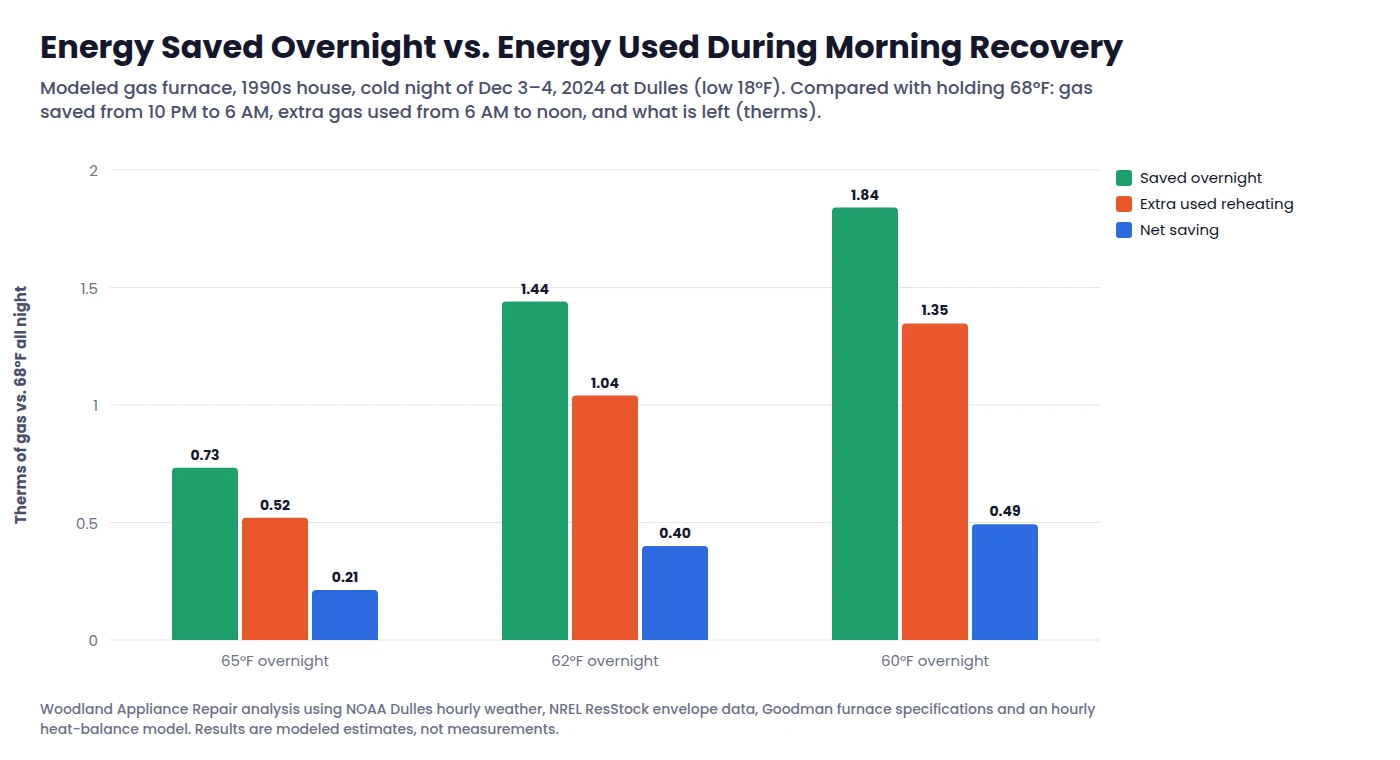
This is the most common belief about setbacks. On the cold night, the morning warm-up used back about 71% to 73% of the gas the setback saved overnight. The remaining 27% to 29% was a real saving. On the cool night the warm-up used back 72% to 77%.
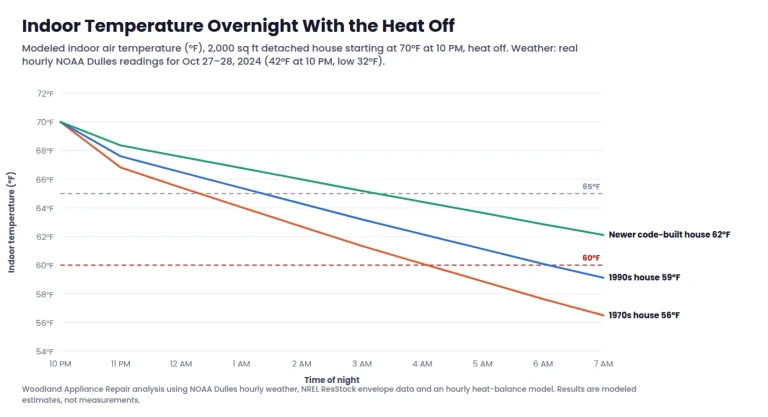
Here’s why. A house loses heat in proportion to how much warmer it is than the outdoors. At 62°F instead of 68°F, it leaks heat more slowly all night. The morning warm-up only puts back the heat stored in the air, walls and furniture, not the heat that never leaked out. A single-stage furnace also doesn’t “work harder” after a setback. It puts out the same heat at any set point and simply runs longer, as a DOE and NREL thermostat fact sheet explained back in 1997.
The night thermostat setting for a heat pump is different
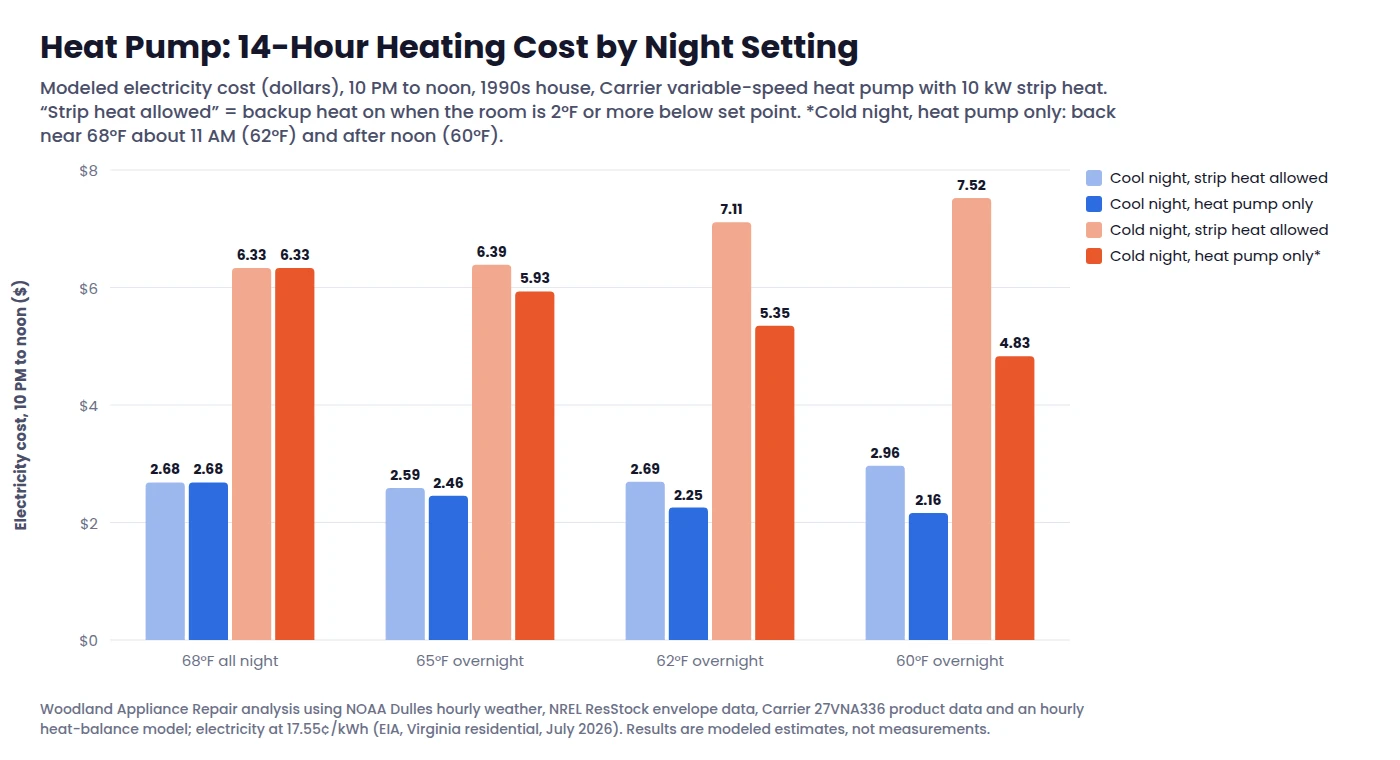
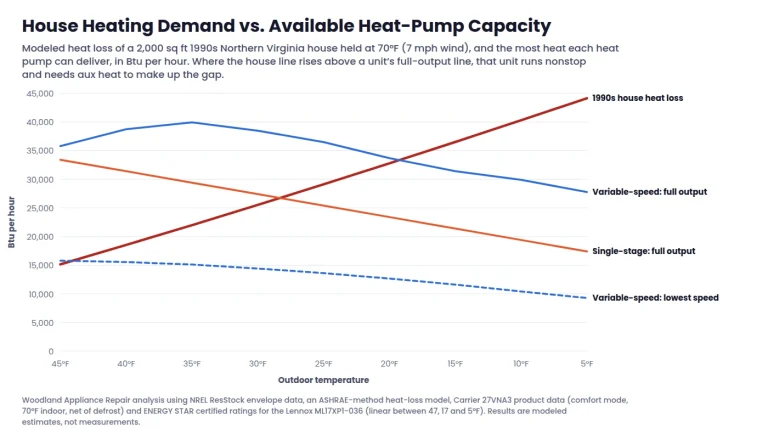
Heat pumps flip the answer. Based on Carrier’s data, this heat pump makes about 2.7 to 3.9 units of heat per unit of electricity at the temperatures we tested. Strip heat makes exactly one. When a deep night thermostat setting lets strip heat run in the morning, the warm-up gets expensive.
With strip heat allowed, the 65°F setback was close to break-even, and the 62°F and 60°F setbacks cost 12% to 19% more than holding 68°F on the cold night. Strip heat ran for about 1.2 to 1.7 hours in those cases. With strip heat never allowed, every setback saved money, but the heat pump alone recovered slowly: after a 62°F night at 18°F, the room didn’t get back near 68°F until about 11 AM. Part of that “saving” is simply a cooler house.
Holding 68°F all night never triggered strip heat. Even at 17°F to 19°F, the heat pump alone kept the room within half a degree of 68°F.
What this means for your home
- Gas furnace: a lower night thermostat setting saves gas, and a deeper setback saves more. The morning warm-up doesn’t cancel it. Want it warm by 6 AM? Schedule the return to 68°F a little earlier.
- Heat pump: a small setback of about 3°F is the safer choice. The DOE advises against manually setting back a heat pump if it causes backup electric-resistance heat to come on, and recommends a programmable or smart thermostat with functions suitable for a heat pump.
- Modest dollars: the best night was worth under a dollar here. DOE estimates you can save as much as 10% a year by turning the thermostat down 7°F to 10°F for 8 hours a day. That’s an annual benchmark, not something our two nights measured, but it points the same way as our furnace results.
- Freezing weather: the American Red Cross advises keeping the same temperature day and night when pipes could freeze. The best night thermostat setting then is no setback at all.
When your results could differ
- Two-stage or modulating furnaces: their recovery logic differs from our single-stage furnace.
- Heat-pump thermostats: some start the warm-up early or limit strip heat by outdoor temperature, which changes the best night thermostat setting.
- Your house: a leakier house usually saves more from a setback; a tight newer house saves less.
- Equipment size: a different heat pump or strip heater size changes how often strip heat runs.
- Sun: we left out morning sunshine, which helps a real house warm up.
- Other loads: we counted heating energy only, not the furnace blower’s electricity.
Safety guidance
Turning the heat down is never a reason to turn it off in freezing weather. The American Red Cross recommends suspending lower nighttime temperatures when pipes are at risk, and never setting the heat below 55°F if you’re away. Pipes in exterior walls, garages and crawl spaces can be much colder than the thermostat’s room. If your thermostat shows aux or emergency heat every morning, have the system checked.
Our thermostat repair techs can check that your thermostat is set up for your equipment, and our heat pump repair page covers systems that lean on backup heat. Furnace owners can book a $99 heating tune-up with our furnace repair team before the first hard freeze.
Heat pump running on aux every morning?
We can usually be there the same day across Prince William and Fairfax counties. Use code FREECALL and the service call is free with your repair.
Thermostat repair in Northern Virginia
A thermostat that’s set up wrong for a heat pump can turn a money-saving setback into a costly one. Woodland handles thermostat repair across Prince William, Fairfax, Loudoun and Fauquier counties, plus Arlington and Alexandria. We’re based in Woodbridge, so Woodbridge, Manassas, Dumfries and Lorton are usually same-day calls, and we’re in Fairfax, Centreville, Springfield, Arlington and Alexandria every week. See our thermostat repair page or call (703) 335-1009.
Sources and methodology
Methodology: a simplified hourly heat-balance model of one 1990s house, used instead of a full EnergyPlus simulation so real Dulles weather could run through the same house with one change at a time. Each run starts at 68°F at 10 PM and ends at noon, split at 6 AM into overnight and morning energy.
Assumptions: 15% window-to-wall ratio, 8-ft ceilings, foundation losses to 50°F ground, 1,500 Btu/h of internal heat, no solar gain, and heat stored in air and furnishings (1 Btu/°F per sq ft) and building mass (6 Btu/°F per sq ft). The 2°F strip-heat rule is our assumption, not a manufacturer setting. Furnace cost counts gas only.
Checks: the model’s heat loss at 14°F is about 37,000 Btu/h, below the furnace’s 64,000 Btu/h output. Differences in where each furnace run ends at noon are under 7% of its savings. These are modeled estimates for one representative house, not measurements of real homes.
- NOAA NCEI Global Hourly (Integrated Surface Database), Washington Dulles International Airport — hourly temperature and wind, Nov 9–10 and Dec 3–4, 2024 (historical observation)
- NREL ResStock housing characteristics, Virginia region — insulation, windows and air leakage for 1990s homes
- Goodman GM9S80 specification sheet (SS-GM9S80-U) — furnace input and output (manufacturer specification)
- Carrier 27VNA3 Infinity Variable Speed Heat Pump product data — heating capacity and power by outdoor temperature (manufacturer specification)
- Carrier FE5B fan coil product data — approved 10 kW electric heater
- U.S. Department of Energy, Energy Saver Guide (2022) — setback benchmark and heat-pump setback advice
- DOE/NREL fact sheet, Automatic and Programmable Thermostats (1997) — furnace recovery explanation (historical DOE guidance)
- American Red Cross, preventing frozen pipes — day-and-night thermostat advice in freezing weather
- EIA, Virginia residential natural gas price — $1.616 per therm, Nov 2025–Jun 2026 average at 1,037 Btu per cubic foot
- EIA Electric Power Monthly, Table 5.6.A — 17.55¢ per kWh, Virginia residential, July 2026
Safety note: Thermostat results depend on heating-system type, controls, home construction, weather, and occupant needs. Do not use these results as a universal minimum-temperature recommendation.
Important Disclaimer
This article is for general educational purposes and is based on virtual testing, simulations, data analysis, published research, and the assumptions described in the article unless a physical test is specifically stated. Results are estimates and may differ based on your home, equipment, installation, maintenance, weather, usage, and other conditions. Do not recreate unsafe conditions or rely on these results as a substitute for manufacturer instructions, official safety guidance, or advice from a qualified professional. Woodland Appliance Repair, LLC makes no guarantee that these results will apply to your specific situation and disclaims warranties and liability to the fullest extent permitted by law.
Need a repair? We can usually be there today.
Locally owned and operated in Woodbridge. Licensed & insured, EPA 608 certified, with 15+ years fixing appliances, heating and cooling across Northern Virginia. $69 service call, free with the repair.