Before You Turn On the Heat: A 10-Minute Furnace Maintenance Checklist
Quick answer
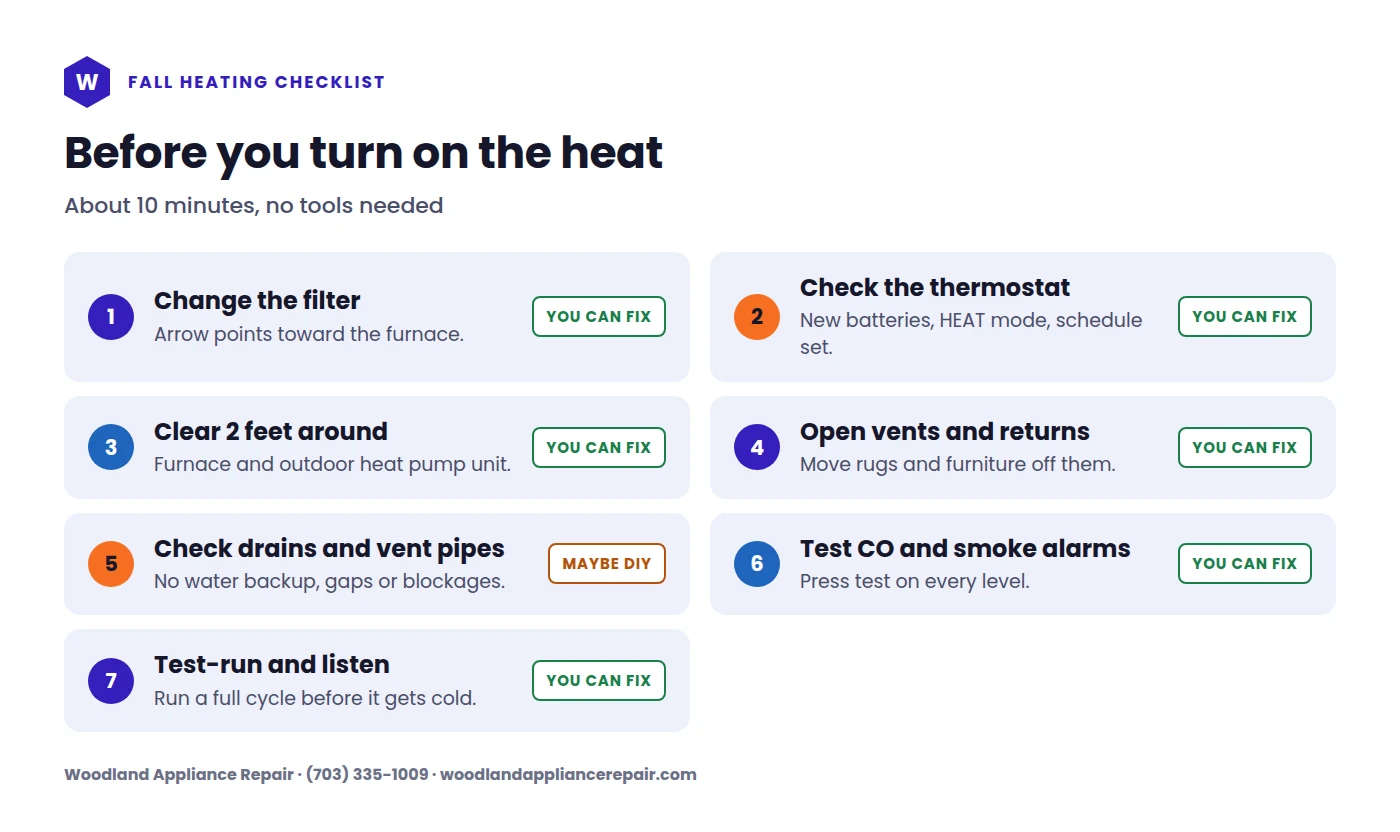
Furnace maintenance checklist in short: change the filter, check the thermostat, clear space around the furnace and outdoor unit, open the vents, check the condensate drain and vent pipes, test your CO and smoke alarms, then run the heat for one full cycle and listen. It takes about 10 minutes. Do it on a mild day so you have time to get help if something is off.
In Northern Virginia, the first cold nights tend to arrive all at once, and that’s when heating calls stack up. A furnace or heat pump that sat all summer is easier to check on a 65-degree afternoon than at 6 am with the house at 58 degrees. This furnace maintenance checklist covers what a homeowner can safely do without tools or opening any panels.
Your furnace maintenance checklist: 9 steps
Work through the steps in order. None of them involve gas, refrigerant or wiring. If a step turns up a problem, the note under it says whether it’s a quick fix or a call.
1. Change the air filter
You can fix this
Turn the system off at the thermostat, slide out the old filter and note the size printed on its frame. The new one goes in with the airflow arrow pointing toward the furnace or air handler. ENERGY STAR’s maintenance checklist says to inspect, clean or change filters once a month. A fresh filter is the cheapest thing you can do for airflow and comfort.
2. Check the thermostat batteries and settings
You can fix this
Put in fresh batteries if your thermostat uses them, even if the screen still looks fine. Switch the mode from COOL to HEAT and make sure the fan is on AUTO. Review your heating schedule, since summer settings won’t make sense in January, and confirm the clock is right so the schedule runs on time.
3. Clear around the furnace and the outdoor heat pump unit
You can fix this
Indoors, keep boxes, laundry and storage back from the furnace, and never keep gasoline, paint or solvents in the same room. Outdoors, a heat pump unit needs about 2 feet of open space on every side. Rake out leaves, trim back shrubs and pull out anything wedged against the coil. Don’t cover a heat pump for winter, because it runs all season.
4. Open the supply vents and clear the returns
You can fix this
Walk through the house and open every supply register you closed for summer. Closing too many vents raises pressure in the ducts and makes the system work harder. Then find the return grilles, the larger ones that pull air back to the system, and move any rugs, couches or curtains that block them.
Found a problem on your furnace maintenance checklist?
We can usually be there the same day across Prince William and Fairfax counties. Use code FREECALL and the service call is free with your repair.
5. Check the condensate drain
Maybe a DIY fix
High-efficiency furnaces make water while they heat, and it drains through a plastic line or a small pump. ENERGY STAR lists the condensate drain as a regular check. Look for water on the floor, a cracked or kinked line, or a pump that doesn’t switch on. To test a pump, pour a cup of water into its reservoir and listen for it to run.
6. Test the carbon monoxide and smoke alarms
You can fix this
Press the test button on every alarm and replace batteries where needed. Check the date on the back of each unit, since alarms have a replacement age. The CPSC recommends CO alarms on every level of the home and outside sleeping areas. Any home with a gas furnace, gas water heater or attached garage should have them.
7. Look at the flue and vent pipes
Call a technician
Follow the vent pipe from the top of the furnace to where it leaves the house. A metal flue should have tight joints with no rust holes, gaps or sagging sections. A PVC vent should have no cracked or separated joints. Outside, make sure the vent and intake openings aren’t blocked by leaves or nests. If a section is loose or disconnected, don’t run the furnace. Call a technician.
8. Test-run the heat before the first cold night
You can fix this
Set the thermostat a few degrees above room temperature and let the system run a full cycle, about 10 to 15 minutes. Warm air should reach the vents within a few minutes. A light dusty smell the first time is normal. If nothing happens, our post on a furnace not turning on walks through what to check.
9. Listen for odd noises
Maybe a DIY fix
While it runs, stand near the furnace and the outdoor unit. A steady hum and airflow are normal. Rattling, squealing, grinding or a loud bang when the burners light are not. Neither is clicking that repeats without the heat starting. Note when the sound happens and tell the technician.
What a professional tune-up adds to your furnace maintenance checklist
Your furnace maintenance checklist covers what you can see and hear. A tune-up covers what’s behind the panels. ENERGY STAR recommends a heating check-up every fall. In general, a heating tune-up includes:
- Checking gas connections, gas pressure and burner combustion
- Inspecting the heat exchanger for cracks and corrosion
- Testing the safety controls, including limit and pressure switches
- Cleaning the flame sensor and checking the igniter
- Tightening electrical connections and measuring voltage and current on motors
- Checking the condensate drain, and on heat pumps, the defrost operation
Woodland’s heating tune-up is $99. Book it before the first freeze, when heating repair schedules fill up. If you have a heat pump, we also handle heat pump repair.
From our technician
“What I like finding on a fall tune-up are parts that still work but are starting to show trouble: a weak igniter, a dirty flame sensor, a capacitor getting weak, a loose electrical connection, a condensate line starting to plug up, a burner issue or something questionable with the venting.
Those are exactly the things you want to find in October instead of after the furnace quits on a 20-degree night.”
Nick, Senior Technician, EPA-certified, experience since 2008
When to call a technician
- The system won’t start or won’t make warm air during the test run
- A vent pipe is loose, rusted through or disconnected
- Water keeps backing up from the drain or pump
- You hear banging, grinding or squealing
- A burning smell lasts more than an hour, or your CO alarm sounds
If you smell gas or your CO alarm goes off, stop the checklist. Get everyone outside to fresh air, then call 911 or your gas company from outside the house.
Heating repair in Northern Virginia
If your checklist turns up a problem, it’s easier to fix in October than in January. Woodland handles heating repair across Prince William, Fairfax, Loudoun and Fauquier counties, plus Arlington and Alexandria. We’re based in Woodbridge, so Woodbridge, Manassas, Dumfries and Lorton are usually same-day calls, and we’re in Fairfax, Centreville, Springfield, Arlington and Alexandria every week. See our heating repair page or call (703) 335-1009.
What a visit costs with Woodland
Whether you book a tune-up or a repair, the price is set before any work starts.
$69
Service call, waived completely when you go ahead with the repair
$99
Heating or AC tune-up to catch problems before the season turns
90 days
Warranty on parts and labor
Same price any day we’re open, including evenings and Saturdays. There’s no travel fee.
Frequently asked questions
How long does a furnace maintenance checklist take?
Most homes get through a furnace maintenance checklist in about 10 minutes. The filter, thermostat and alarm checks take a few minutes each, and the test run adds another 10 to 15 minutes of waiting.
When should I do my furnace maintenance checklist?
Do it in early to mid October, before the first cold night. A mild day gives you time to fix a problem or book a visit before you need the heat.
Do I need a tune-up if I did the checklist myself?
The checklist catches easy problems you can see. A tune-up checks combustion, gas pressure, safety controls and the heat exchanger, which need tools and training. ENERGY STAR recommends a heating check-up every fall.
Should I cover my heat pump for winter?
No. A heat pump heats your home all winter, so it needs open airflow. Keep about 2 feet clear around it and remove leaves and snow.
How much is a heating tune-up with Woodland?
Our heating tune-up is $99. If the technician finds something that needs repair, you get a flat quote before any work.
Need a repair? We can usually be there today.
Locally owned and operated in Woodbridge. Licensed & insured, EPA 608 certified, with 15+ years fixing appliances, heating and cooling across Northern Virginia. $69 service call, free with the repair.