Is Your Heat Pump Running All Night? We Tested What Happens as Outdoor Temperatures Keep Dropping
Quick answer
Heat pump running constantly in cold weather? That’s usually normal. In our model of a 1990s Northern Virginia house, a variable-speed heat pump ran nonstop at every temperature from 35°F down, simply slowing down or speeding up to match the house. It needed help from aux heat only below about 19°F. A single-stage heat pump ran 75% of the time at 35°F and needed aux heat below about 28°F.
It’s a cold January night. You get up for a glass of water and hear the outdoor unit humming, just like it was at dinner. It hasn’t shut off in hours. Is it broken, is it too small, or is a heat pump running constantly just what heat pumps do?
We tested it, virtually. This is a computer model, not a test on real equipment: we calculated how much heat a typical Northern Virginia house loses at five outdoor temperatures and compared it with the published heating capacity of two real heat pumps. It matters now: in each of the last 10 years, Dulles recorded its first low of 25°F or colder in November.
What we tested
One 2,000 sq ft 1990s house, held at 70°F, at five outdoor temperatures: 45°F, 35°F, 25°F, 15°F and 5°F. At each one we compared the house’s heat loss with what two heat pumps can deliver.
- Heat pump 1: Carrier Infinity 27VNA336, a 3-ton variable-speed, ENERGY STAR cold-climate unit that can run anywhere between its lowest and highest speed
- Heat pump 2: Lennox MERIT ML17XP1-036, a 3-ton single-stage unit that is either fully on or off
- Measured in the model: house heat loss, available capacity, capacity margin, efficiency (COP), runtime, aux heat needed and electricity cost per hour
- Bonus check: how often each unit would have run nonstop during the real winter of December 2024 to February 2025 at Dulles
- Result type: modeled estimates and manufacturer specifications, not measurements
How we ran the heat pump test
The house is the same 1990s home used throughout our experiment series: two stories, 2,000 sq ft, R-11 walls, R-30 attic, double-pane windows and average air leakage for its age, taken from NREL’s ResStock housing database for Virginia. The model adds up heat lost through the walls, attic, windows, foundation and air leaks, with a steady 7 mph breeze and 1,500 Btu per hour from people and appliances.
| Input | Value used | Where it comes from |
|---|---|---|
| Indoor temperature | 70°F | Matches the manufacturer’s rating condition |
| House heat loss at 14°F | 37,300 Btu/h (about 19 Btu/h per sq ft) | Our model, ResStock envelope data |
| Variable-speed heat pump | 27,800–39,900 Btu/h at full speed; 9,300–15,800 at lowest speed | Carrier 27VNA3 product data, net of defrost |
| Single-stage heat pump | 34,200 Btu/h at 47°F, 22,200 at 17°F, 17,400 at 5°F | ENERGY STAR certified ratings |
| Aux heat | 10 kW electric strip heater, COP 1.0 | Carrier-approved heater for this system |
| Electricity price | 17.55¢ per kWh | EIA, Virginia residential, July 2026 |
A variable-speed heat pump doesn’t simply turn on and off. It slows down when the house needs a little heat and speeds up when it needs a lot, so we report how hard it’s working rather than an on-off percentage. It cycles only when the house needs less than its lowest speed. The single-stage unit really is on or off, so for it we report the share of each hour it runs.
Results: when a heat pump runs nonstop
Here’s the heat pump running constantly question, temperature by temperature. “Aux” is the extra heat the electric strip heater must supply because the heat pump can’t keep up alone. The single-stage unit’s ratings don’t include enough efficiency data to price its electricity.
| Outdoor temp | House needs (Btu/h) | Variable-speed unit | Electricity cost per hour | Single-stage unit |
|---|---|---|---|---|
| 45°F | 15,200 | Lowest speed, on about 96% of the time | $0.20 | On 45% of the time |
| 35°F | 22,000 | Nonstop at 55% of full output | $0.31 | On 75% of the time |
| 25°F | 29,100 | Nonstop at 80% of full output | $0.48 | Nonstop, short 3,700 Btu/h (aux) |
| 15°F | 36,500 | Full output, short 5,100 Btu/h (aux) | $0.88 | Nonstop, short 15,100 Btu/h (aux) |
| 5°F | 44,100 | Full output, short 16,400 Btu/h (aux) | $1.46 | Nonstop, short 26,700 Btu/h (aux) |
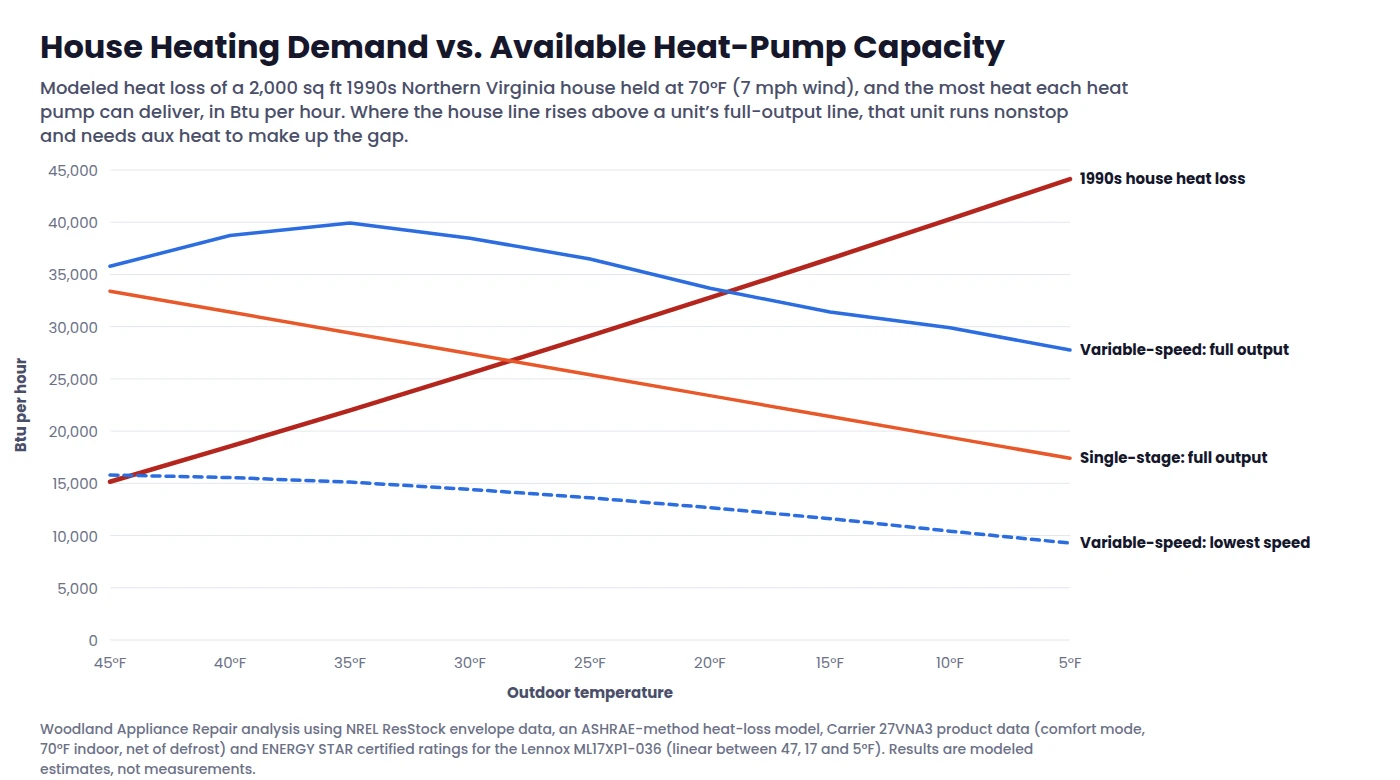
The chart shows the whole story in two crossing lines. As it gets colder, the house loses more heat. At the same time, a heat pump has less heat available outdoors to collect, so its full output drops. Where the lines cross is the balance point. In our model that’s about 19°F for the variable-speed unit and about 28°F for the single-stage unit. Above the balance point the heat pump handles the house alone. Below it, the heat pump runs flat out and aux heat fills the gap.
The dashed line is the variable-speed unit’s lowest speed. The house’s heat loss stays above that line at almost every temperature below about 45°F. That means a well-matched variable-speed heat pump running constantly is doing exactly what it was designed to do: running slowly and steadily rather than blasting on and off.
Is a heat pump running constantly a problem? What the model shows
Mostly, no. A heat pump running constantly was the normal state of affairs last winter. We ran the same house through every hour of last winter at Washington Dulles International Airport, December 2024 through February 2025, using NOAA’s hourly temperatures. The variable-speed heat pump would have run nonstop for about 83% of those 2,160 hours. Aux heat would have been needed for only 137 hours, all below 20°F, and would have supplied about 4% of the season’s heating electricity.
The single-stage unit would have run about 71% of all winter hours and needed aux heat in 598 of them, about 28% of the winter, because its capacity falls faster in the cold. For both units, a heat pump running constantly was normal. The difference is how much expensive backup heat each one leans on.
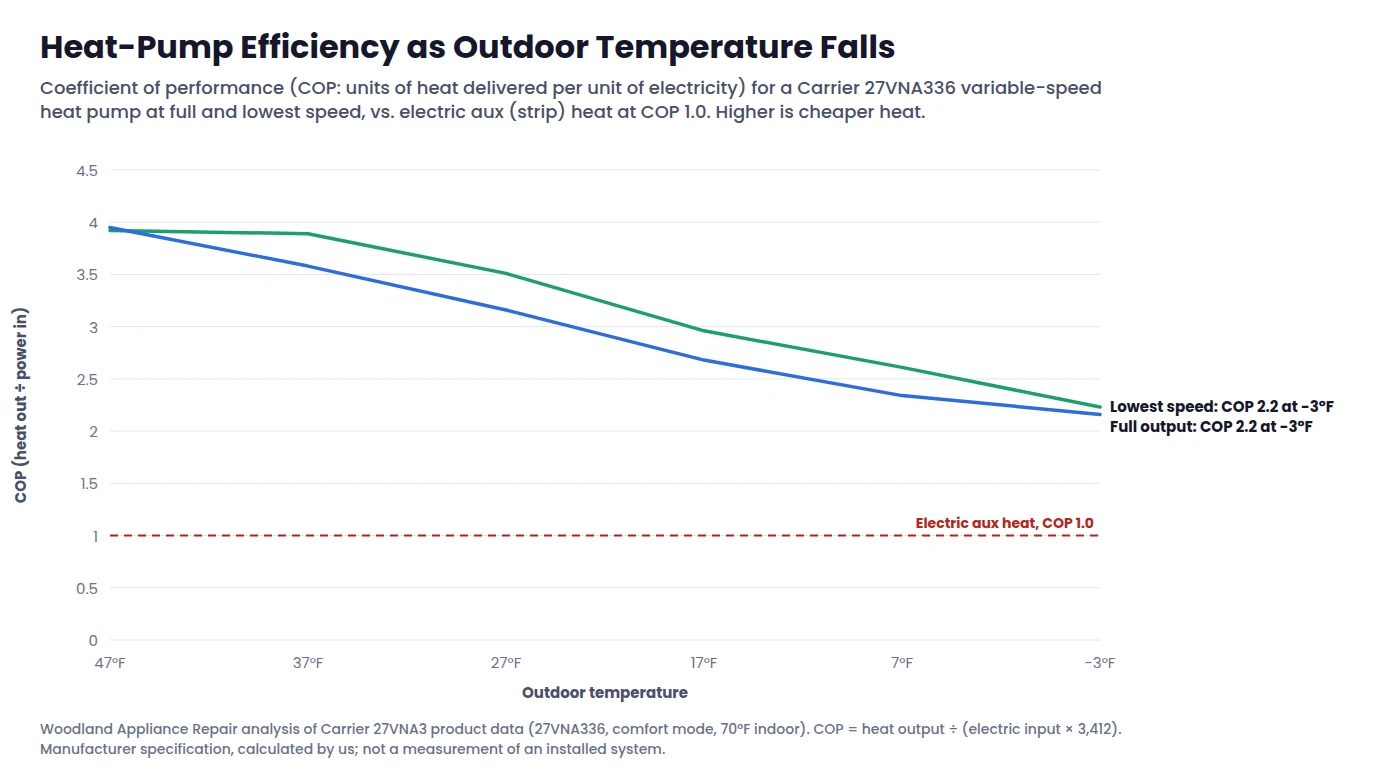
The second chart explains why aux heat costs so much more. A heat pump moves heat rather than making it. According to Carrier’s data, this unit delivers about 4 units of heat for each unit of electricity at 47°F, about 2.7 at 17°F and still about 2.2 at -3°F. The electric strip heater behind it makes exactly 1 unit of heat per unit of electricity, at any temperature. That’s why the hourly cost in our table jumps from $0.48 at 25°F to $1.46 at 5°F, when more than half of the electricity is going to aux heat.
What this means for your home
- Nonstop running in the 20s and 30s is normal for a variable-speed heat pump and common for a single-stage one. Judge it by whether the house holds its temperature, not by how long the unit runs.
- Aux heat below the 20s is normal too. “AUX” on the thermostat during a cold snap usually means the heat pump has reached its balance point and is getting help.
- A heat pump running constantly on a mild day is different. If it’s 45°F to 50°F outside and the house can’t reach its set point, or aux runs for hours, something else may be going on.
- Big thermostat changes cost more. DOE advises against manual setbacks on a heat pump if they make backup resistance heat come on, because that heat is more expensive.
When your heat pump could behave differently
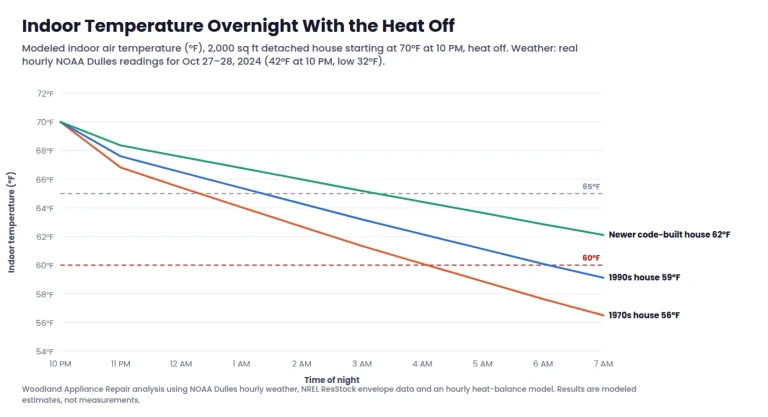
- House age and size: the balance point moves with the house. In our model the same variable-speed unit covered a newer code-built house down to about 6°F, but a leaky 1970s house only down to about 29°F.
- Wind: we assumed a steady 7 mph breeze. In calm air, the 1990s house’s balance point dropped to about 17°F.
- Sizing: both units are 3-ton models. A different size shifts every number.
- Defrost: the published capacities already subtract the effect of defrost cycles, but real defrost behavior varies with humidity, and many systems run aux heat briefly during defrost.
- Rated vs. real: ENERGY STAR lists this Carrier system at a COP of 2.06 at 5°F; the product-data figure we used works out to about 2.3. Installed performance depends on ductwork, refrigerant charge and airflow.
- Controls: thermostats and equipment use different rules for when aux heat comes on. Ours is a simple “only when the heat pump can’t keep up” rule.
Safety and manufacturer guidance
Don’t try to fix a heat pump running constantly by switching off aux or emergency heat, changing lockout temperatures or altering the outdoor unit. Backup heat may be what keeps the house warm during a cold snap and during defrost. DOE’s Energy Saver guide recommends a smart or programmable thermostat with functions suited to a heat pump. To help prevent frozen pipes in freezing weather, the American Red Cross advises keeping the thermostat at the same temperature day and night. For anything beyond changing the thermostat setting, follow your manufacturer’s manual.
If your heat pump is running and the house is still falling behind on a mild day, the outdoor coil stays encased in ice, or the air from the vents never feels warm, it’s time for a technician. Woodland’s heat pump repair techs diagnose these problems with a $69 service call, waived with the repair, and a flat quote before any work. If the issue is the thermostat’s aux settings, our thermostat repair page covers that too. A $99 heating tune-up before winter is a good time to check refrigerant, airflow and defrost operation.
Heat pump running constantly and the house still cold?
We can usually be there the same day across Prince William and Fairfax counties. Use code FREECALL and the service call is free with your repair.
From our technician
We asked Nick about calls for a heat pump running constantly in winter.
“One of the most common winter calls is “my heat pump is blowing cold air” or “the outdoor unit is smoking.” Maybe a third of those turn out to be the homeowner seeing a normal defrost cycle for the first time. The coil frosts up, the system reverses for a few minutes, and you can get a big cloud of steam outside.
What isn’t normal is a unit that stays encased in ice, never clears itself, or seems to go into defrost constantly.”
Nick, Senior Technician, EPA-certified, experience since 2008
Heat pump repair in Northern Virginia
A heat pump running constantly in January is usually normal; one that can’t keep up on a 45°F day usually isn’t. Woodland handles heat pump repair across Prince William, Fairfax, Loudoun and Fauquier counties, plus Arlington and Alexandria. We’re based in Woodbridge, so Woodbridge, Manassas, Dumfries and Lorton are usually same-day calls, and we’re in Fairfax, Centreville, Springfield, Arlington and Alexandria every week. See our heat pump repair page or call (703) 335-1009.
Sources and methodology
Methodology: at each outdoor temperature we compared the steady heat loss of the house at 70°F indoors with each heat pump’s capacity. Carrier’s table (-3 to 47°F) and the three ENERGY STAR rating points for the single-stage unit are interpolated in straight lines. That ignores extra frost loss between 17°F and 45°F, so if anything it flatters the single-stage unit.
Costs use the power listed in Carrier’s table plus aux heat; indoor fan power may not be included. Winter check: last winter’s 2,160 Dulles hours were grouped into 5°F bins, with no sun and the house held at 70°F. Sanity check: the house loses about 19 Btu/h per sq ft at 14°F, a normal range, and Carrier’s 5°F product-data capacity is within 2% of its ENERGY STAR rating. The NEEP cold-climate list could not be accessed for this analysis. These are modeled estimates, not measurements of installed systems.
- Carrier, 27VNA3 Infinity Variable Speed Heat Pump Product Data (27VNA3-01PD) — heating capacity and power at full and lowest speed, comfort mode, 70°F indoor (manufacturer specification)
- ENERGY STAR Certified Air-Source Heat Pumps dataset — Carrier 27VNA336 rated capacity and COP at 5°F; Lennox ML17XP1-036 (AHRI 210048433) rated capacity at 47, 17 and 5°F
- Carrier, FE5B Infinity Series Fan Coil Product Data (FE5B-04PD) — approved 10 kW electric heater
- NOAA NCEI Global Hourly (Integrated Surface Database), Washington Dulles International Airport — hourly temperatures, Dec 2024–Feb 2025 (historical observation)
- NREL ResStock housing characteristics, Virginia region — insulation, windows and air leakage by era
- U.S. EIA, Electric Power Monthly, Table 5.6.A — Virginia residential electricity, 17.55¢/kWh, July 2026
- U.S. Department of Energy, Energy Saver Guide (2022) — heat pump thermostat and setback guidance
- Craighead Electric Cooperative, Understanding Emergency Heat (2024) — utility explanation of when aux heat engages, including defrost
- American Red Cross, preventing frozen pipes — cold-weather guidance
- Model: steady-state heat-loss model with the LBL stack-and-wind infiltration method (ASHRAE Handbook of Fundamentals) — run by Woodland Appliance Repair
Safety note: Do not disable auxiliary heat, alter compressor lockout settings, or change manufacturer controls based solely on this simulation. Heat-pump performance varies by model, sizing, installation, controls, and building load.
Important Disclaimer
This article is for general educational purposes and is based on virtual testing, simulations, data analysis, published research, and the assumptions described in the article unless a physical test is specifically stated. Results are estimates and may differ based on your home, equipment, installation, maintenance, weather, usage, and other conditions. Do not recreate unsafe conditions or rely on these results as a substitute for manufacturer instructions, official safety guidance, or advice from a qualified professional. Woodland Appliance Repair, LLC makes no guarantee that these results will apply to your specific situation and disclaims warranties and liability to the fullest extent permitted by law.
Need a repair? We can usually be there today.
Locally owned and operated in Woodbridge. Licensed & insured, EPA 608 certified, with 15+ years fixing appliances, heating and cooling across Northern Virginia. $69 service call, free with the repair.