Clocks Fall Back Sunday: A 15-Minute Home Safety Check, and What to Do If Your Carbon Monoxide Alarm Goes Off
Quick answer
Carbon monoxide alarm going off? Get everyone out to fresh air right away, including pets, then call 911 or the fire department from outside. Don’t go back in until responders say it’s safe. Before you use the furnace or other gas appliances again, have a technician find the source.
Daylight saving time ends on Sunday, November 1, 2026, and the clocks fall back an hour. In Northern Virginia, it lands just as heating season gets going. It’s a good day to test alarms and look over the heating system, because carbon monoxide comes from fuel-burning appliances, and the furnace is the one working hardest.
Carbon monoxide alarm going off? Do this first
A carbon monoxide alarm going off isn’t something to troubleshoot. Follow these steps in order.
- Get out. Move everyone, including pets, outside to fresh air. Don’t stop to open windows or look for the source.
- Call from outside. Call 911 or the fire department once you’re out of the house.
- Stay out. Don’t go back in until the fire department says it’s safe.
- Watch for symptoms. Headache, dizziness, weakness, nausea, sleepiness or confusion can mean CO exposure. Tell the 911 operator if anyone feels sick.
- Find the source before you restart anything. Have a technician check the furnace, water heater and other gas appliances before you use them again.
Carbon monoxide has no color or smell. The U.S. Consumer Product Safety Commission says that if you suspect CO poisoning, get outside to fresh air immediately and then call 911. It also reports that more than 200 people in the U.S. die every year from accidental non-fire CO poisoning linked to consumer products. If you smell gas, leave the house without flipping switches and call your gas company or 911 from outside.
Carbon monoxide alarm going off? Get the furnace checked before you run it again
We can usually be there the same day across Prince William and Fairfax counties. Use code FREECALL and the service call is free with your repair.
Alarm, chirp or end of life? Read the beeps
A chirp isn’t the same as a carbon monoxide alarm going off. Patterns vary by brand, so check the label on the back of yours. On the two major brands, the patterns look like this.
| What you hear | What it usually means |
|---|---|
| 4 beeps, a pause, 4 beeps, repeating | Carbon monoxide detected. Get out and call 911. |
| A single chirp about once a minute | Low battery. Replace it right away. |
| A chirp every 30 seconds on a Kidde alarm after 7 years | End of life. Replace the alarm. |
| 5 beeps every minute on a First Alert alarm | End of life. Replace the alarm. |
Kidde says its CO alarms begin an end-of-life chirp seven years after first power-up and recommends new alarms if yours were installed 5 to 7 years ago. If you aren’t sure whether you’re hearing an alarm or a chirp, treat it as an alarm and get outside.
The 15-minute fall-back safety check
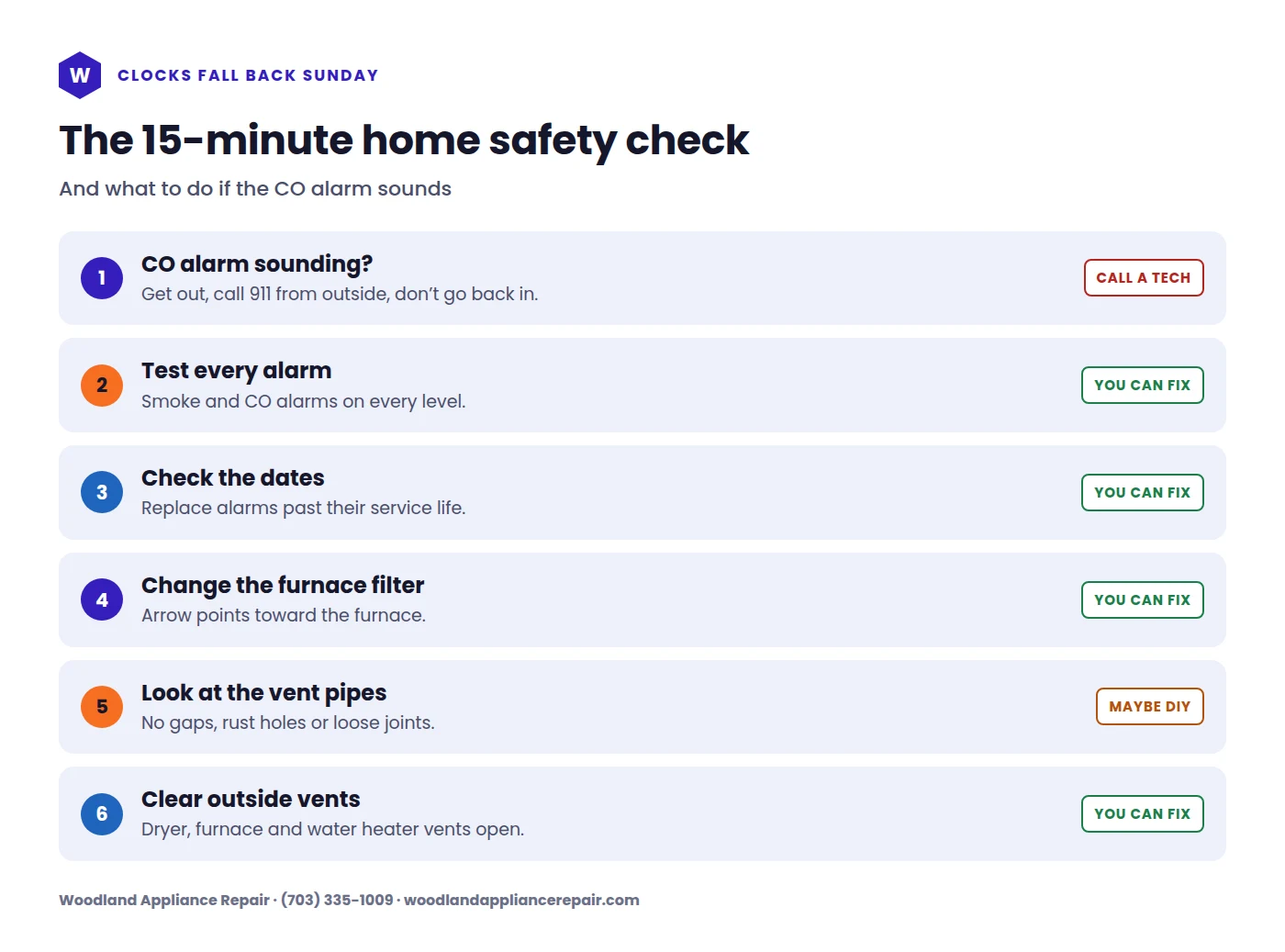
Do these on Sunday while you change the clocks. None of them involve gas, wiring or opening panels.
1. Test every smoke and CO alarm
You can fix this
Press the test button on each one and listen for the full alarm. CPSC teaching materials say to test CO alarms monthly. For smoke alarms, the U.S. Fire Administration says to test them monthly, replace 9-volt batteries at least once a year, and replace the whole alarm every 10 years.
2. Check placement and dates
You can fix this
The CPSC recommends CO alarms on every level of the home and outside sleeping areas. Check the manufacture date on the back of each alarm and replace any that are past the service life on the label.
3. Change the furnace filter
You can fix this
A clogged filter makes the furnace overheat and cycle on its safety switches. Slide in a clean one with the airflow arrow pointing toward the furnace.
4. Look at the vent pipes
Maybe a DIY fix
Follow the vent pipe from the top of the furnace and the water heater to where it leaves the house. Look for gaps, rust holes, loose joints or a section that has sagged. If you find one, don’t run the appliance. Call a technician.
5. Clear the outside vents
You can fix this
The U.S. Fire Administration says to keep vents for the dryer, furnace, stove and fireplace clear of snow and other debris. In early November, that usually means leaves and old nests. Clear the openings by hand.
6. Run cars and generators outside only
You can fix this
Never leave a car running in an attached garage, even with the door open. If you keep a portable generator for winter outages, the USFA says to use it outdoors in a well-ventilated area, away from doors, windows and vents.
Why the furnace gets checked after a CO alarm
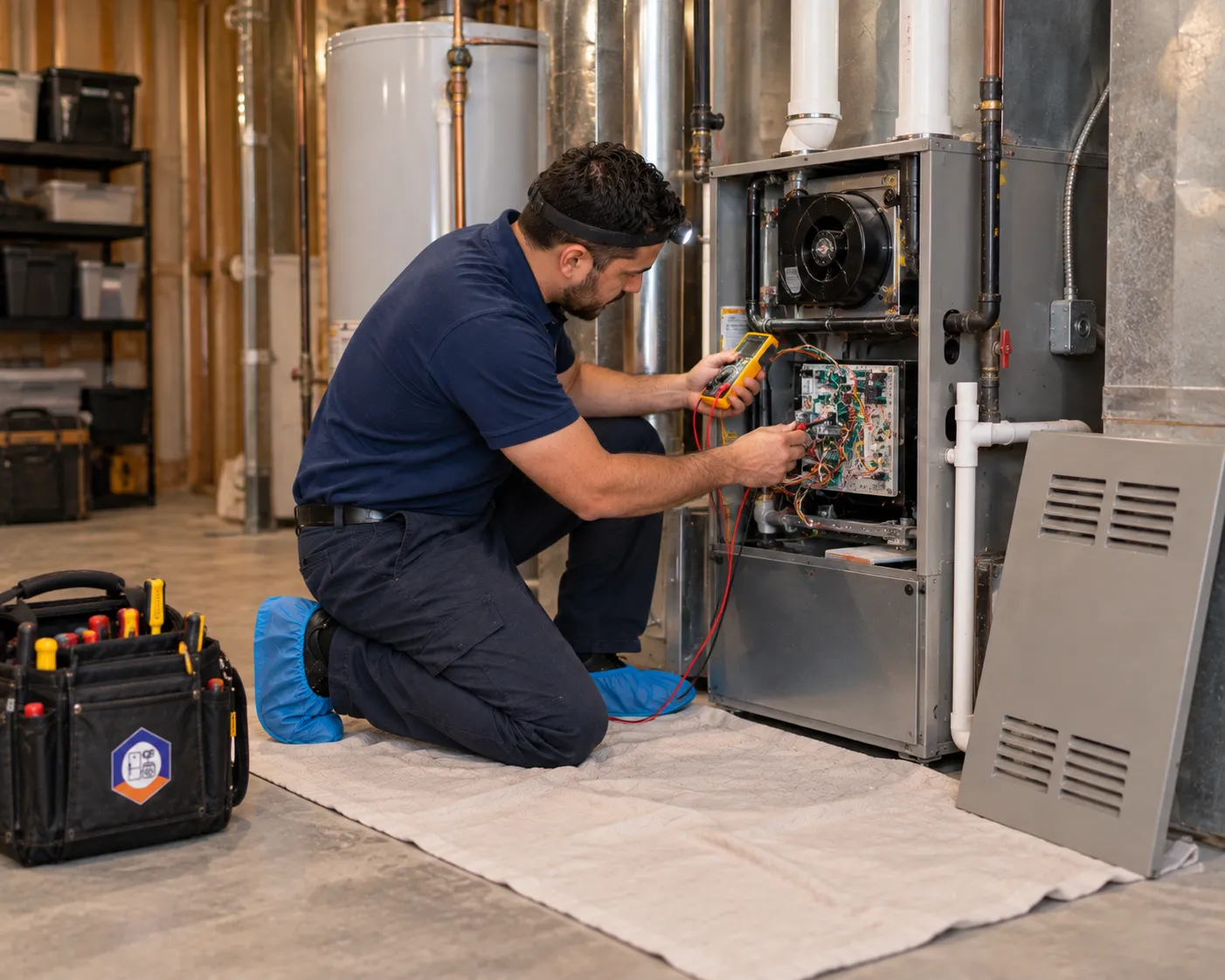
A gas furnace burns fuel inside a sealed heat exchanger and sends the exhaust out through a vent pipe. If the heat exchanger cracks, the vent is blocked or disconnected, or the burners aren’t burning cleanly, combustion gases can end up in the house. A technician checks combustion, the heat exchanger and the vent from end to end. If the furnace isn’t the source, the water heater, gas range and fireplace are next on the list. Our furnace repair page covers what we fix on the heating side. After any carbon monoxide alarm going off, that check comes before anyone turns the heat back on.
From our technician
“What I like finding on a fall tune-up are parts that still work but are starting to show trouble: a weak igniter, a dirty flame sensor, a capacitor getting weak, a loose electrical connection, a condensate line starting to plug up, a burner issue or something questionable with the venting.
Those are exactly the things you want to find in October instead of after the furnace quits on a 20-degree night.”
Nick, Senior Technician, EPA-certified, experience since 2008
When to call a technician
- After any carbon monoxide alarm going off, once the fire department clears the house
- A vent pipe is loose, rusted through or disconnected
- The furnace bangs when it lights, or the burner flame looks yellow or lazy
- Soot appears around the furnace, water heater or vent
- You haven’t had the heating system checked since last winter
Furnace repair in Northern Virginia
A furnace that has been checked before winter is one less thing to worry about. Woodland handles furnace repair across Prince William, Fairfax, Loudoun and Fauquier counties, plus Arlington and Alexandria. We’re based in Woodbridge, so Woodbridge, Manassas, Dumfries and Lorton are usually same-day calls, and we’re in Fairfax, Centreville, Springfield, Arlington and Alexandria every week. See our furnace repair page or call (703) 335-1009.
What a visit costs with Woodland
You get a flat quote before any work starts. Our $99 heating tune-up includes a heat exchanger inspection and a gas pressure and venting check. See our heating repair page for what else we fix.
$69
Service call, waived completely when you go ahead with the repair
$99
Heating or AC tune-up to catch problems before the season turns
90 days
Warranty on parts and labor
Same price any day we’re open, including evenings and Saturdays. There’s no travel fee.
Frequently asked questions
What should I do if my carbon monoxide alarm is going off?
Get everyone outside to fresh air right away, then call 911 or the fire department from outside. Don’t go back in until responders say it’s safe. Then have a technician check your gas appliances before you use them.
Can a carbon monoxide alarm going off be a false alarm?
It can, but you can’t tell from inside the house. Treat every alarm as real, get out and call 911. Responders can test the air and tell you when it’s safe.
Why is my CO alarm chirping?
A single chirp about once a minute usually means a low battery. A different repeating chirp can mean the alarm has reached end of life. Check the label, since patterns vary by brand.
How often should I replace CO alarms?
Follow the date on the label. Kidde says its alarms begin an end-of-life chirp after seven years and recommends replacing alarms installed 5 to 7 years ago.
Can my furnace cause a carbon monoxide alarm going off?
Yes. A cracked heat exchanger, a blocked or disconnected vent, or burners that aren’t burning cleanly can all let CO into the house. A technician should check the furnace before you run it again.
Need a repair? We can usually be there today.
Locally owned and operated in Woodbridge. Licensed & insured, EPA 608 certified, with 15+ years fixing appliances, heating and cooling across Northern Virginia. $69 service call, free with the repair.