Why Is My Dryer Running but Not Heating? (And When It’s a Fire Risk)
Quick answer
Dryer not heating while the drum still turns? The usual causes are a clogged lint screen or vent that makes the dryer shut its heat off, a tripped half of the 240-volt breaker on an electric dryer, or a no-heat cycle like air fluff. If those check out, a heat part has failed, such as the thermal fuse, the heating element, or a gas dryer’s igniter. A thermal fuse that blows again after replacement points to a blocked vent and a real fire risk.
Fall is when we hear about a dryer not heating most in Northern Virginia, as heavier clothes, bedding and sports gear fill every load. Most of the causes are simple to check, and a few matter for safety as much as for dry clothes. To skip straight to help, see our dryer repair page.
What “running but not heating” tells you
A dryer has two separate jobs. The motor turns the drum and the blower, and the heat source warms the air the blower pulls through the clothes. When the drum spins and the air stays cold, the motor side is fine and the problem sits in the heat side or in the airflow that the heat side depends on.
Several safety parts cut the heat when the air inside gets too hot, and poor airflow is the most common reason it does. That’s why a technician checks the vent before any part inside the cabinet.
Dryer not heating: 7 causes in diagnostic order
1. A clogged lint screen or dryer vent
You can fix this
Lint that gets past the screen collects in the duct behind the dryer and in the run to the outside wall. With the airflow choked, heat builds up fast. The cycling thermostat and the high-limit thermostat open to protect the dryer, so the heat runs for a short time and then shuts off while the drum keeps turning. Clothes come out warm on the surface and damp inside.
Clean the lint screen, then check the duct behind the dryer for crushing or kinks. With the dryer running, make sure the outside flap opens and the airflow feels strong. A vent this blocked is the most common reason for a dryer not heating.
2. Half of the 240-volt breaker tripped (electric dryers)
You can fix this
An electric dryer runs on a double breaker. The motor and controls only need 120 volts from one side of it. The heating element needs the full 240 volts across both sides. If one half trips, the drum still turns and the lights still come on, but the element gets nothing. Find the dryer’s double breaker in your panel, switch it fully off, then back on. A breaker that trips again needs a technician or an electrician.
3. The wrong cycle is selected
You can fix this
Air fluff, air dry and some wrinkle or refresh settings tumble with no heat on purpose. On many dryers the temperature is a separate knob or button, and it’s easy to bump it to the no-heat position. Choose a timed dry cycle on high heat and run it for five minutes before you go further.
Dryer not heating? We can usually come today.
We can usually be there the same day across Prince William and Fairfax counties. Use code FREECALL and the service call is free with your repair.
4. A blown thermal fuse
Maybe a DIY fix
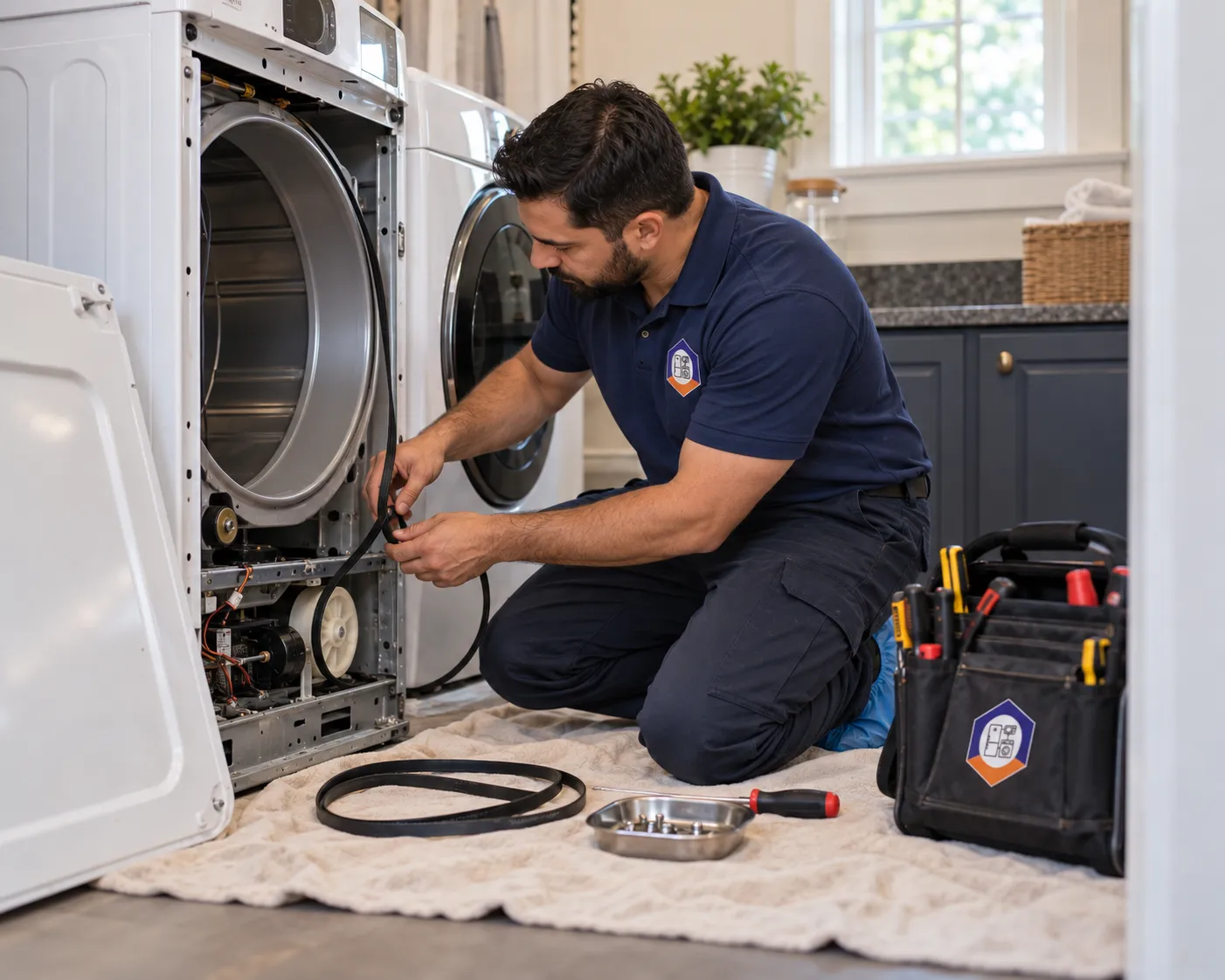
Both electric and gas dryers have a thermal fuse. It’s a one-time safety part that opens when the dryer overheats and can’t be reset. Depending on the model, a blown fuse either cuts the heat only or keeps the dryer from starting at all. The question is why it blew. Usually the answer is poor venting, and a new fuse on a blocked vent just blows again.
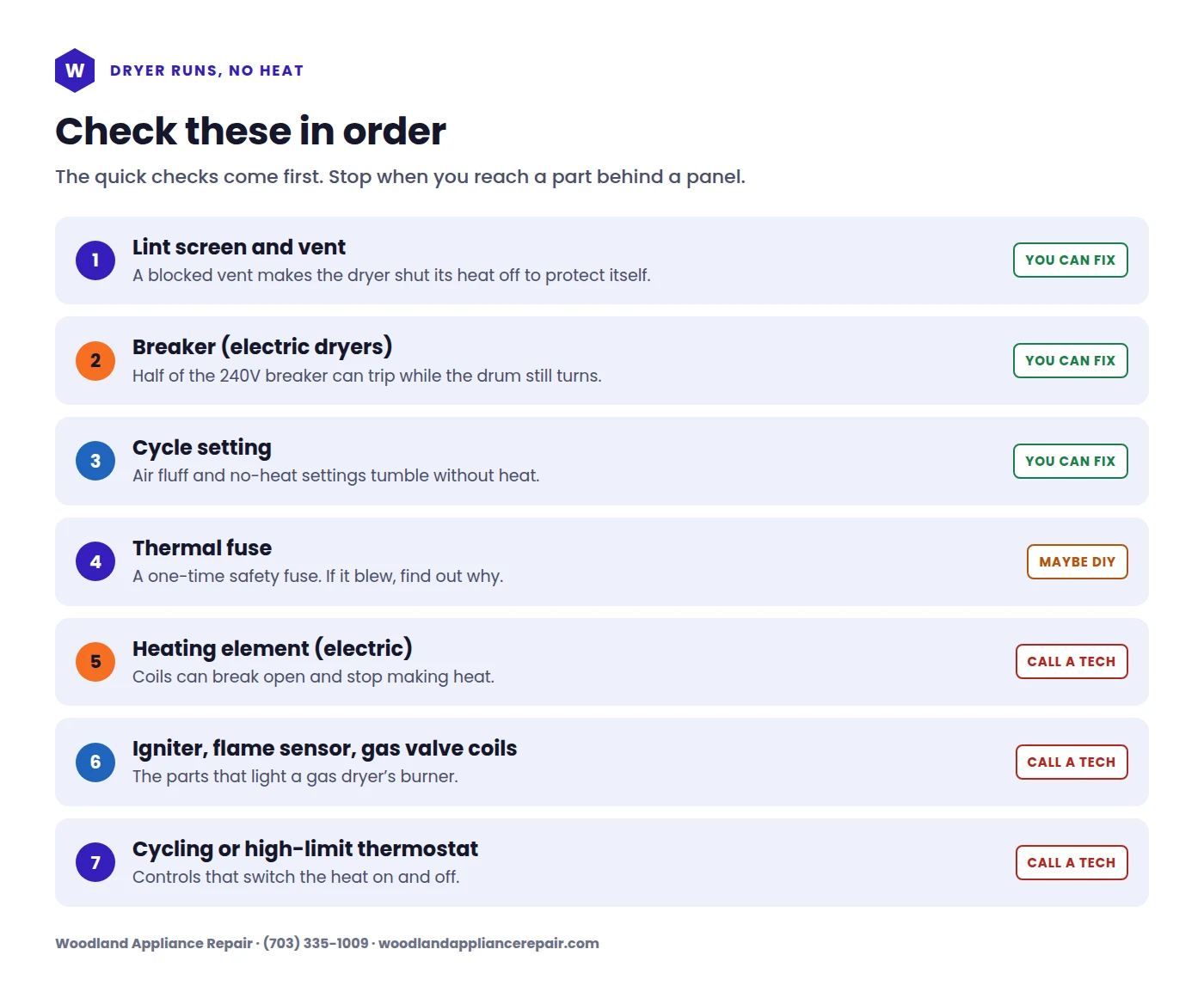
5. A failed heating element (electric dryers)
Call a technician
The element is a coil of resistance wire inside a metal housing. The coil can break open, or sag and short against the housing. Testing it means opening a 240-volt appliance and using a meter, so leave it to a technician.
6. Gas dryers: igniter, flame sensor or gas valve coils
Call a technician
A gas dryer lights its burner in steps. The igniter glows bright orange, the flame sensor confirms the igniter is hot, and the gas valve coils open to let gas flow. If the igniter never glows, the igniter or the flame sensor is the usual suspect. If it glows and then goes dark with no flame, the valve coils often need replacing. Every one of these parts sits next to the gas line, so this is a job for a technician.
If you smell gas near the dryer, stop. Don’t switch anything on or off. Leave the house and call your gas company or 911 from outside. Before opening any dryer panel, unplug the dryer or turn off its breaker, and on a gas dryer close the gas shutoff.
7. A bad cycling or high-limit thermostat
Call a technician
The cycling thermostat switches the heat on and off to hold the temperature you picked. The high-limit thermostat is a backup that cuts the heat if the cycling thermostat fails. Either one can stick open, which gives no heat, or stick closed, which lets the dryer run too hot. A technician tests them along with the vent, since a thermostat that keeps tripping is usually reacting to poor airflow.
When a dryer not heating is a fire risk
Usually a dryer not heating is just an annoyance. The exception is when a safety part tripped. According to the U.S. Fire Administration’s report on clothes dryer fires in residential buildings, an estimated 2,900 home dryer fires are reported each year, and failure to clean was the leading factor, at 34 percent. That report covers 2008 to 2010, but lint in the dryer and its vent is still the problem we find most.
- You replaced the thermal fuse and it blew again. The vent problem was never fixed.
- The top or sides of the dryer feel hot to the touch during a cycle.
- You smell something hot or burning, or see lint around the back of the dryer or the outside vent.
- The vent flap outside barely moves when the dryer runs.
If you see any of these, stop using the dryer until the vent has been cleaned and the cause is found.
From our technician
“On an electric dryer that tumbles but has no heat, the heating element and the thermal protection are high on my list. On a gas dryer, I’m looking at the igniter, the flame sensor and the gas-valve coils.
If the complaint is “it gets hot, but now it takes two cycles,” the vent jumps way up the list. Poor airflow makes a dryer run hotter and longer, and eventually it takes other parts out with it.”
Nick, Senior Technician, EPA-certified, experience since 2008
When to call a technician
- The breaker, lint screen, vent and cycle all check out and there’s still no heat
- A thermal fuse has blown more than once
- You have a gas dryer and the igniter doesn’t glow, or glows with no flame
- The breaker trips again after you reset it
- The dryer runs too hot, smells like burning, or shuts off on its own
Dryer repair in Northern Virginia
A dryer not heating is a common repair in the fall, and a clogged vent is often the reason. We clean dryer vents too. Woodland handles dryer repair across Prince William, Fairfax, Loudoun and Fauquier counties, plus Arlington and Alexandria. We’re based in Woodbridge, so Woodbridge, Manassas, Dumfries and Lorton are usually same-day calls, and we’re in Fairfax, Centreville, Springfield, Arlington and Alexandria every week. See our dryer repair page or call (703) 335-1009.
What a visit costs with Woodland
The diagnostic is $69, waived with the repair, and you get a flat quote before any work starts. New customers can also use our coupons.
$69
Service call, waived completely when you go ahead with the repair
$99
Heating or AC tune-up to catch problems before the season turns
90 days
Warranty on parts and labor
Same price any day we’re open, including evenings and Saturdays. There’s no travel fee.
Frequently asked questions
Why is my dryer running but has no heat?
A dryer not heating while the drum turns usually has a blocked vent tripping its safety thermostats, a tripped half of the 240-volt breaker, or a no-heat cycle selected. If those are fine, look at the thermal fuse, heating element, or the gas burner parts. Check the easy things first.
Can I keep using a dryer not heating properly?
If the cause is a no-heat cycle or a breaker, yes, once it’s fixed. If the heat keeps cutting out or the thermal fuse blew, stop using it until the vent is checked. Running a dryer on a blocked vent is how lint fires start.
Is a thermal fuse something I can replace myself?
The part is simple, but it only blew because the dryer overheated. Replacing it without fixing the airflow means it will blow again. Unplug the dryer first, and call a technician if you aren’t sure why it blew.
Why does my gas dryer heat for a few minutes and then stop?
A gas dryer that heats and then goes cold often has weak gas valve coils that fail once they warm up. A blocked vent can cause the same symptom. Because it involves gas, have a technician test it.
How much does it cost to fix a dryer not heating?
With Woodland it’s a $69 diagnostic, waived with the repair, and a flat quote before any work. You’ll know the full price before we start.
Need a repair? We can usually be there today.
Locally owned and operated in Woodbridge. Licensed & insured, EPA 608 certified, with 15+ years fixing appliances, heating and cooling across Northern Virginia. $69 service call, free with the repair.